
Steering & Approving AI Agents: Human-in-the-Loop
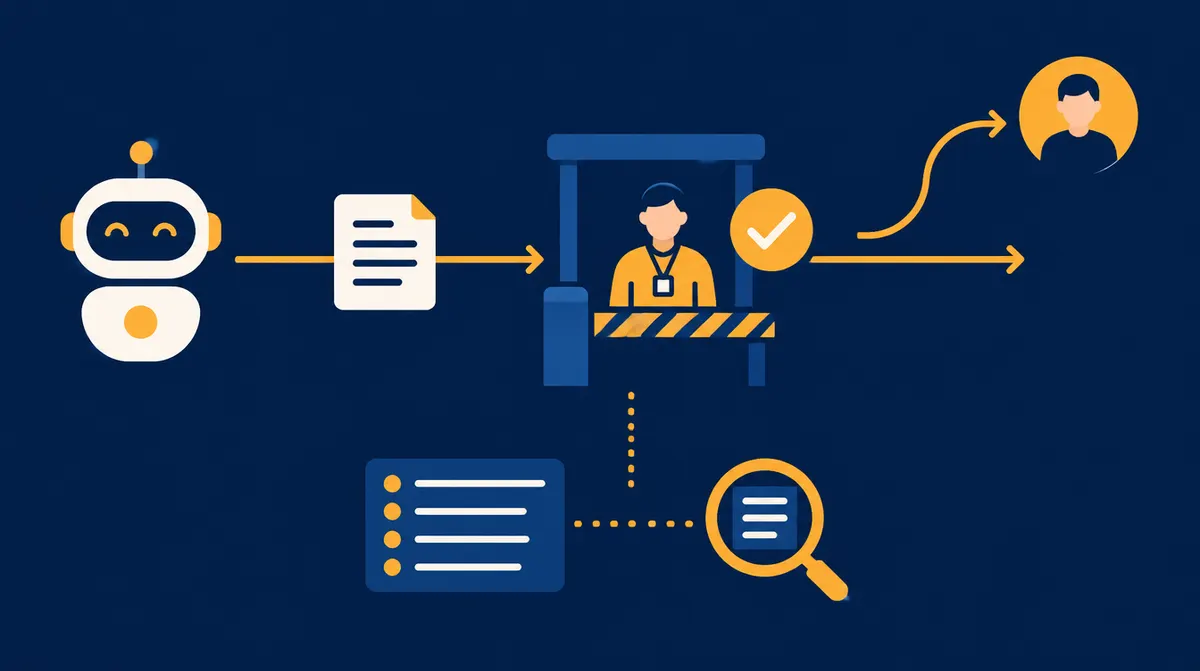
In short: AI agents stay controllable when four things are defined: approval levels (what the agent may do alone and what only after approval), escalation rules (when it hands over to a person), spot checks (who checks how often) and a complete log. In the company cockpit your team sees all of this in one place – and decides instead of cleaning up.
The biggest barrier to AI agents in SMEs isn't technology, it's trust. In a YouGov survey of 438 decision-makers for bevh and Alibaba.com (September 2026), 32% named lack of trust in the technology as a barrier – more than any other reason. That is justified: an agent that answers e-mails or sends quotes on its own needs clear limits. This article shows how to set them.
Human-in-the-loop vs. human-on-the-loop
| Model | How it works | Suitable for |
|---|---|---|
| Human-in-the-loop | The agent prepares, a person approves every single action. | Quotes, invoices, orders – anything with financial or legal effect |
| Human-on-the-loop | The agent acts itself; a person monitors, spot-checks and intervenes when something looks off. | Answering calls, booking appointments, status updates, sorting the inbox |
| Human-out-of-the-loop | The agent acts without human control. | Not recommended for customer-facing tasks in SMEs |
In practice this matches the levels in the org chart with AI agents: "AI + human" is human-in-the-loop, "fully AI" is human-on-the-loop.
The four building blocks of control
1. Define approval levels
Every agent task gets one of three levels: may act (e.g. book an appointment), may prepare (e.g. quote draft – sent only after approval), may not (e.g. promise prices, grant discounts). These levels are written down in the agent's "job description".
2. Define escalation rules
A good agent knows when it's not responsible. Typical triggers for handing over: a complaint or angry tone, an amount above a threshold, an unknown situation, an explicit request for a human, uncertainty about the answer. What matters is to whom – in the cockpit the case lands directly with the responsible role.
3. Plan spot checks
Even with "fully AI", a person checks regularly. Densely at first (e.g. a handful of cases daily), less often once quality is stable. Errors found flow back to the agent as a rule or example.
4. Log everything
Every agent action is stored: what came in, what it did, what it relied on, who approved. The log is the basis for spot checks, error analysis and evidence for customers, auditors or authorities.
Least-privilege access
An agent gets only the access its task needs. The phone agent reads the calendar but not accounting. The receipts agent writes drafts into the accounting system but doesn't post them. That limits the damage of any error – and keeps the data protection impact assessment manageable. More: Sovereign AI for SMEs.
KPIs that belong in the cockpit
| KPI | What it shows |
|---|---|
| Cases completed per agent | How much work the agent actually takes over |
| Approval rate without changes | How good the drafts are – if it rises, control can be loosened |
| Escalation rate | How often the agent hands over – too high means rules or knowledge are missing |
| Open approvals | Where your team becomes the bottleneck |
| Handling time | How fast customers get an answer |
| Errors from spot checks | Where to sharpen |
How to derive the business value: Calculating AI ROI.
What the EU AI Act requires
- Transparency (Art. 50): since 2 August 2026, people must be informed that they are interacting with an AI – e.g. when an agent answers calls or chats – unless this is obvious.
- High-risk applications: AI in areas such as recruitment or credit decisions faces strict duties, including effective human oversight. Under the Digital Omnibus, the full requirements for these cases (Annex III) apply from 2 December 2027.
- Automated decisions (GDPR Art. 22): decisions with legal or similarly significant effects on a person should not be left to an agent alone.
Most SME agents – phone, inbox, quotes, receipts – are not high-risk systems. A clean approval logic is still the best preparation. Details: EU AI Act 2026 and AI governance for SMEs. This section is not legal advice.
How your team steers in the company cockpit
In the company cockpit with AI agents the four building blocks come together. Each role sees its open approvals, escalated cases and agent results in the team portal. Management sees the KPIs across all positions. And because mysoftwarelab runs the cockpit as an external AI department, monitoring, maintenance and improvement of the agents are not your team's job – your team only decides.
FAQ: steering AI agents
How do I stay in control of AI agents?
With approval levels per task, clear escalation rules, regular spot checks and a complete log of all agent actions.
What does human-in-the-loop mean?
The agent prepares a task; a person reviews and approves every single action before it takes effect.
May an AI agent communicate with customers on its own?
Yes, for suitable tasks such as booking appointments or status updates. Since 2 August 2026, customers must be able to recognise that they are dealing with an AI (Art. 50 EU AI Act).
How much of my team's time does control take?
More at first, because spot checks are dense. As the approval rate without changes rises, control is loosened step by step – the cockpit KPIs show when.
Conclusion: trust comes from visibility
AI agents aren't trustworthy because the model is good, but because every step is visible and every critical action is approved. Set this up from the start and you can let agents work with a clear conscience.
Company cockpit with AI agents
The agents work, your team decides.
Callback within 24 hours – then see in a clickable prototype what approvals would look like in your cockpit.
Request a callback → Packages & pricingSources
Who builds your company cockpit
Benefit from over 20 years of enterprise experience
Andreas Indorf
Managing Director, mysoftwarelab GmbH
Qualification: Founder of mysoftwarelab GmbH; with his team, builds company cockpits with AI agents for SMEs
Expertise: Over 20 years of developing and implementing IT systems for DAX companies and international corporations. Specialized in AI automation for mid-sized businesses since 2021.
Hands-on Experience: As a model operation, mysoftwarelab already runs 80% of its own IT services through AI. This hands-on experience flows directly into our client consulting.
Focus: Company cockpits in which AI agents take over recurring tasks – for companies with 5+ employees, built and run by us.
E-E-A-T Proof: All information complies with Google's E-E-A-T guidelines (Experience, Expertise, Authoritativeness, Trustworthiness) for high-quality consulting content.
Which of your tasks belong in the cockpit?
In a free callback we clarify whether a company cockpit with AI agents fits your business – for companies with 5+ employees.
- An individual company cockpit instead of single AI tools
- AI agents take over recurring tasks, your team approves
- Built and run by us – fixed monthly price
From the lab
The most important AI news of the week – as a comic.
Every Wednesday, ByteUndGlitch explains one real AI story in eight panels. Satirical, accessible, free.
Read the latest episode