

Specialized AI agents: job profiles, not all-purpose AI
In short: Specialized AI agents don't just "help out somehow". They fill a defined role, such as payroll accountant, HR officer or receptionist, based on a real job profile. Each specialist comes with expertise, working rules, checklists, clear limits and a fixed approval rule. That turns a language model into a colleague whose work you can plan, check and take responsibility for. Whether a specialist works in standard operation, a sensitive field or a regulated profession determines how much it may decide on its own.
Most companies in Germany now use AI: according to the industry association Bitkom, 57% of companies with 20 or more employees, up from 36% a year earlier. AI agents are far less common: 11% already use them and 29% are planning to. Bitkom president Ralf Wintergerst puts it this way: an agent needs "reliable data, connected systems and rules". Rules are exactly where many first attempts fail. A general-purpose agent is told "do the bookkeeping" and delivers results that are sometimes right and sometimes wrong, and nobody can say why. This article shows how AI agents by role are built, what the three tiers are, how to staff a position in your org chart with a specialist, and how to recognise a good AI specialist, including from other vendors.
General-purpose AI vs. specialist: why "do the bookkeeping" fails
A large language model knows a lot about accounting. What it doesn't know is how your accounting works: which chart of accounts you use, above which amount a second person has to approve, what must happen when a supplier's bank details change, or when a case goes to your tax advisor. A general-purpose agent fills those gaps with plausible assumptions. The result looks professional and still isn't reliable.
Typical problems with general-purpose agents in a business:
- No standard: without a checklist there is no "done" and no "correct". Every output has to be fully re-checked, so little time is saved.
- No limits: the agent also answers questions it shouldn't, for example on tax structuring or whether a dismissal is valid.
- No accountability: nobody has defined who approves. So either nobody approves, or everyone relies on everyone else.
- No repeatability: the same task gives a different result this week than last week, because the prompt is phrased differently each time.
A specialist solves this by being described exactly the way you would fill a job: with a job profile, work instructions, control steps and authority levels.
| Feature | General-purpose agent | Job-specific AI agent |
|---|---|---|
| Assignment | Free-form prompt | Defined role with a job profile |
| Expertise | General world knowledge | Professional knowledge plus your own documents |
| Way of working | Varies with the prompt | Fixed working rules, the same every time |
| Quality control | Afterwards, by a human | Built-in checklists before handover |
| Limits | Implicit or none | Explicit: what it never does |
| Approval | Unclear | Fixed approval rule per result |
| Responsibility | Diffuse | A named person in the org chart |
What makes specialized AI agents work: five building blocks
An AI specialist is not a different language model. It is a carefully written profile that an AI agent works with. In the mysoftwarelab specialist pool, every profile consists of the same five building blocks:
- Expertise: what the profession needs to know. For a bookkeeper (payables and receivables): receipt capture and account assignment, payment matching, discounts and due dates, and dunning according to your levels. Plus your own knowledge from documents, ERP and CRM.
- Working rules: how the work is done. Example from the same profile: "Never accept changed bank details without call-back confirmation." Rules like this come from professional practice and prevent typical losses.
- Checklists: what is checked before every handover, such as mandatory invoice details, invoice against order and delivery note, due dates and discount periods.
- Limits: what the specialist never does. The bookkeeper doesn't release payments, makes no goodwill or deferral decisions, and reports suspected fraud to a human immediately.
- Approval rule: who signs off the result. Here: "Your team approves payments and dunning from level 2."
This structure isn't new. It is what good companies define for new employees anyway. The difference: with a person, much of it lives in their head. With an AI agent it has to be written down, otherwise it doesn't exist.
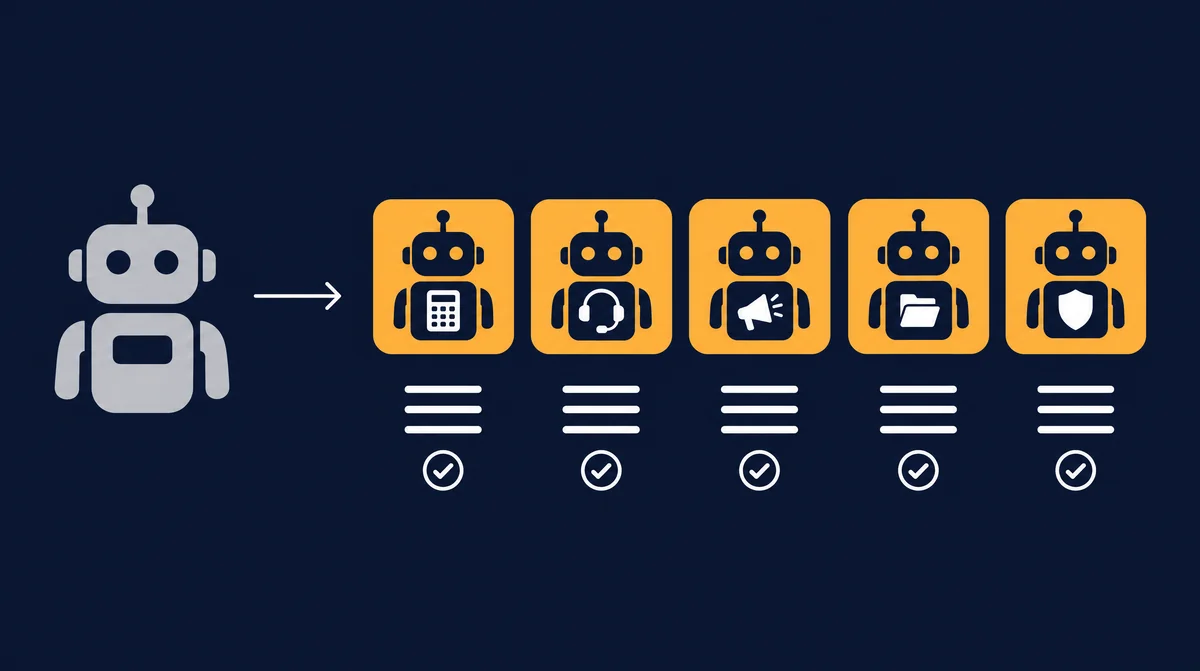
The three tiers: standard operation, sensitive field, regulated profession
Not every profession tolerates the same degree of autonomy. That's why every specialist in the pool is assigned to one of three tiers. The tier defines how approval works in principle.
| Tier | Approval | Examples from the pool |
|---|---|---|
| Standard operation | By fixed rules: thresholds, spot checks, exceptions to a human | Bookkeeper, receptionist & phone, sales support, warehouse administrator, marketing manager |
| Sensitive field | Advisory and preparatory only, always approved by a human | HR officer, recruiter, psychologist (work & organisation) |
| Regulated profession | Preparatory only, no advice, approved by the licensed professional | Tax assistant (preparatory), legal assistant (contract review), medical assistant, occupational safety specialist (preparatory) |
The specialist's tier is not the same as the classification of a task in an org chart with AI agents (fully AI, AI + human, human). But it sets the frame: a specialist in a regulated profession can never work "fully AI", while a specialist in standard operation can for many tasks.
Standard operation: approval by fixed rules
In standard operation the specialist works largely on its own. People step in when a rule says so: above an amount, on an exception or through spot checks.
- Receptionist & phone: answers calls, records name, number and request, and books appointments. Working rule: it states at the start that an AI assistant is speaking. Emergencies are forwarded immediately. Limit: no binding commitments on prices or contracts. The EU AI Act also generally requires transparency when people interact with an AI system (Art. 50).
- Sales support: answers inquiries the same day, takes prices only from the current price list and grants discounts only within the approved range. Quotes above your threshold are approved by sales.
- Warehouse administrator: keeps stock figures from the system, never estimated, reorders within the approved range and reports discrepancies immediately. Write-offs are approved by a human.
Sensitive field: advisory, always with human approval
Sensitive fields are about people: their health, their careers, their wellbeing. Here an AI agent may prepare, structure and point things out. It may not decide.
- HR officer: maintains personnel files, prepares contracts, certificates and reference letters, and tracks deadlines such as probation and fixed terms. Limits: no employment-law advice, no warnings, dismissals or assessments of people, no automated personnel decisions. A human approves every document addressed to employees.
- Recruiter: writes job ads, checks them for discriminatory wording and structures applications against the requirements profile, never by age, gender or origin. Your team decides on selection, offers and rejections. This also matters from a regulatory point of view: AI systems used to select candidates are classed as high-risk under Annex III of the EU AI Act. Following the Digital Omnibus, the European Commission states that the rules for these systems apply from 2 December 2027. Check your specific case with legal counsel.
- Psychologist (work & organisation): supports psychosocial risk assessments, employee surveys and team development. In Germany, psychological strain at work is explicitly part of the risk assessment required by Section 5 of the Occupational Safety and Health Act. The specialist works in an advisory and preparatory capacity only: it analyses data only anonymised and aggregated, respects minimum group sizes and never assesses individual people. No diagnosis, no therapy, no individual counselling; it replaces neither psychotherapists nor occupational physicians. The most important rule: signs of crisis go to a human at once, together with support options such as a crisis helpline (in Germany, the free 24/7 TelefonSeelsorge). A qualified professional approves analyses and measures.
For more on HR, read AI in HR.
Regulated profession: preparatory only, approved by the licensed professional
In Germany, tax advice, legal advice and medical treatment are reserved for licensed professions. An AI agent can do a lot of groundwork here, but it doesn't advise. It collects, organises, flags and formulates questions.
- Tax assistant (preparatory): compiles documents for each month, flags VAT anomalies and keeps the deadline calendar. Working rule: formulates questions for the tax advisor instead of answers. Your tax advisor decides and is responsible for everything tax-related.
- Legal assistant (contract review): compares contracts with your templates and flags deviations on term, termination, liability and jurisdiction, each with the exact clause reference. Deviations are flagged, not assessed. Legal assessment and approval stay with your lawyer or legal department.
- Medical assistant (practice organisation): organises appointments, prescription requests and documents. Medical questions always go to the doctor or therapist; in emergencies the specialist immediately refers to the emergency number or the practice. No diagnosis, no interpretation of findings.
The specialist pool at a glance: 51 job profiles in eleven areas
The pool is organised by the areas found in almost every SME org chart, plus industry specialists. The table shows the areas with example job profiles.
| Area | Count | Example job profiles |
|---|---|---|
| Finance & tax | 5 | Payroll accountant, bookkeeper, financial accountant (closing), controller, tax assistant (preparatory) |
| HR | 4 | HR officer, recruiter, learning & development specialist, occupational safety specialist (preparatory) |
| Sales | 5 | Sales support, lead researcher, cost estimator, tender manager, customer success manager |
| Marketing & communication | 10 | Marketing manager, performance marketing, SEO (incl. AI search), social media, content, graphic design, video, e-mail marketing, PR, translation |
| Customers & service | 4 | Customer service, receptionist & phone, order processing, complaints manager |
| Admin & legal | 6 | Executive assistant, purchaser, legal assistant, data protection coordinator, ESG manager, fleet manager |
| IT & data | 4 | IT support (1st level), software developer, data analyst, information security coordinator |
| Production & logistics | 4 | Dispatcher, warehouse administrator, production planner, technical writer |
| Quality & organisation | 3 | Quality manager, project assistant, knowledge manager |
| Industry specialists | 3 | Property management clerk, insurance claims handler, service advisor (trades & workshop) |
| Expert advice & health | 3 | Psychologist (work & organisation), sociologist, medical assistant |
The distribution matches what companies already do with AI. According to Bitkom, 72% of German AI users apply it in customer contact, 54% in marketing and communication and 25% in controlling and accounting, up from 17% the year before. All profiles with expertise, rules, checklists, limits and approval are listed in the specialist pool and positions.
Anatomy of a specialist: the payroll accountant
Payroll shows clearly why a job profile achieves more than a prompt. Payroll is highly repetitive but error-prone: a wrong supplement or a missed parental leave often only surfaces when someone complains.
| Building block | Content of the payroll accountant profile |
|---|---|
| Task | Prepares the monthly payroll. |
| Expertise | Wage types, supplements and benefits in kind; social security, wage tax, mini-job rules; deadlines for filings and contribution statements |
| Working rules | Change master data only with evidence; explain deviations from the previous month; personnel data only in the approved system |
| Checklists | Month-on-month comparison per employee; joiners, leavers, sickness, holidays, parental leave recorded; hours and supplements plausible |
| Limits | No tax or legal advice for employees; never triggers a payroll run or payment itself; special cases such as garnishments or severance go to a human |
| Approval | Payroll runs and filings are always approved by your payroll team or tax office. |
Here's what a month looks like in practice: the specialist collects hours, absences and changes from time tracking and personnel files. It compares every payslip with the previous month and writes a reason for every deviation, such as "night shift supplement +6 hours per time tracking". It recognises a wage garnishment as a special case and hands it over with all documents. Your payroll team then no longer checks every line, only the flagged deviations and special cases, and approves the payroll run. For the wider finance function, see AI in accounting.
Step by step: staffing a role in your org chart with an AI specialist
The specialist pool only delivers its value in the context of your structure. So the path always runs through the org chart, role by role, task by task.
- Pick a role: start with a position under pressure today: a vacancy, overload, long response times.
- List and classify tasks: for each task, decide whether it is fully AI, AI + human or stays human. The questions for this are in the org chart guide.
- Choose the matching specialist: pick the job profile from the pool that fits the role. A position can also get two specialists, such as bookkeeper and controller.
- Adapt the profile to your company: thresholds, discount ranges, dunning levels, tone, systems. The standard rules stay; your values are added.
- Name the approver: one responsible person per specialist who handles exceptions and does spot checks.
- Define data access: only the systems and data the role really needs. Access rights work as they do for employees.
- Start with tight rules: more approvals and spot checks in the first weeks, loosen them once quality is proven.
At mysoftwarelab we prepare your org chart before the first meeting based on your website. In the meeting we go through it role by role and collect all the information. The result is a clickable prototype of your individual cockpit, with specialists already assigned to their roles.
Steer, approve and monitor in the cockpit
A specialist nobody can see isn't being managed. In the company cockpit with AI agents, every specialist is set up exactly where it works in the org chart. For management, that means:
- Steer: you see for each role which specialist works with which profile, and adjust rules or thresholds without touching technology.
- Approve: anything the approval rule sends to a human lands with the responsible person as a task, with reasoning and checklist.
- Monitor: results, exceptions and spot checks are documented and traceable. You can see where a specialist works reliably and where rules need tightening.
How approval levels and human-in-the-loop work in detail is covered in steering and approving AI agents. We use the model ourselves: around 80% of the work at mysoftwarelab is done by AI agents from our own cockpit. Back office and phone, marketing and support run fully on AI. In sales, people lead the conversations while agents research leads, build prototypes and calculate ROI. Tax advice and legal stay external.
Build an AI agent yourself or choose from a pool?
You can create a specialized AI agent yourself. Many platforms offer tools for it. What matters is less the technology than the description of the role. If you build your own, write out the five building blocks for each role: expertise with sources, working rules, checklists, limits and approval rule. Involve the people who do the task today, because they know the exceptions.
The real effort lies in maintenance: rules change, deadlines move, new special cases appear. A pool of ready-made job profiles saves the groundwork but doesn't replace adapting it to your company. Your thresholds, systems and exceptions have to go into the profile either way.
Checklist: how to recognise a good AI specialist
Whether you work with mysoftwarelab, another vendor or build it yourself, these questions help you evaluate.
- Is there a written profile? Expertise, rules, checklists, limits and approval must be documented in readable form, not just "in the prompt".
- Are the limits concrete? "Acts responsibly" is not a limit. "Does not release payments" is.
- Is the approval rule unambiguous? Who approves what, above which value? Is there a named person?
- Does the tier fit the profession? Tax, legal and medical preparatory only; HR and psychology advisory only, with human approval.
- Are sources given? A good specialist backs statements with a receipt, clause reference or data source.
- Is there an escalation path? What happens with suspected fraud, emergencies, signs of crisis or an angry customer?
- Is access limited? The specialist sees only what the role needs.
- Is everything traceable? Every decision, exception and approval is logged.
- Can you adjust rules yourself? You should be able to change thresholds and rules without programming.
- Is transparency maintained? Customers and employees know when they are talking to an AI.
FAQ: specialized AI agents
What are specialized AI agents?
Specialized AI agents fill a defined role in a company based on a real job profile, such as payroll accountant or sales support. They work with a fixed profile of expertise, working rules, checklists, limits and an approval rule.
What is the difference between general-purpose AI and an AI specialist?
General-purpose AI answers everything to the best of its knowledge, but without your rules, without a checklist and without clear limits. An AI specialist follows the same rules every time, checks its result before handover and knows what it must not do and who approves.
Do AI specialists replace tax advisors, lawyers or doctors?
No. In regulated professions AI specialists work in a preparatory capacity only. They compile documents, flag anomalies and formulate questions. Advice, assessment and approval stay with the licensed professional.
Can an AI agent make HR decisions?
No. HR is a sensitive field. The AI specialist prepares documents, tracks deadlines and structures applications. Selection, warnings, dismissals and assessments are always decided by a human. AI used for candidate selection is classed as high-risk under the EU AI Act.
What does an AI specialist for psychology do in a company?
It supports psychosocial risk assessments, surveys and team development, in an advisory and preparatory capacity only. Results are anonymised; there is no diagnosis and no individual counselling. Signs of crisis go to a human at once, together with support options.
How many AI specialists does a company need?
That follows from your org chart. A sensible start is one to three roles under the most pressure today, such as reception, sales support or bookkeeping, then expanding role by role.
Can I create an AI agent for my business myself?
Yes. What matters is a complete role description with expertise, working rules, checklists, limits and approval rule, plus a responsible person. Without these building blocks, even a self-built agent remains a general-purpose agent.
Conclusion: the job profile first, then the agent
AI agents become reliable in a company when they are described like a job: with expertise, working rules, checklists, limits and a clear approval rule. The three tiers of standard operation, sensitive field and regulated profession make sure a specialist decides exactly as much as the profession allows. You deploy specialists through the org chart and lead them in the cockpit. The result is not an experiment but a structure in which it is clear who does what and who is accountable for it.
AI specialist pool
The right AI specialist for every role in your org chart.
Callback within 24 hours. Then you go through your org chart role by role with Andreas Indorf and see in a clickable prototype of your cockpit which specialist works where and who approves.
Request a callback → Browse the specialist poolSources
- Bitkom, press release of 14 September 2026: For the first time, most companies use AI (German)
- KfW Research, Fokus Volkswirtschaft No. 554: AI in SMEs (July 2026, German)
- EUR-Lex: Regulation (EU) 2024/1689 (AI Act), incl. Art. 50 and Annex III
- EUR-Lex: Regulation (EU) 2026/1744 (Digital Omnibus on AI)
- European Commission: AI Omnibus enters into force (27 July 2026)
- German Occupational Safety and Health Act (ArbSchG), Section 5
- TelefonSeelsorge Germany (crisis helpline)
Who builds your company cockpit
Benefit from over 20 years of enterprise experience
Andreas Indorf
Managing Director, mysoftwarelab GmbH
Qualification: Founder of mysoftwarelab GmbH; with his team, builds company cockpits with AI agents for SMEs
Expertise: Over 20 years of developing and implementing IT systems for DAX companies and international corporations. Specialized in AI automation for mid-sized businesses since 2021.
Hands-on Experience: As a model operation, mysoftwarelab already runs 80% of its own IT services through AI. This hands-on experience flows directly into our client consulting.
Focus: Company cockpits in which AI agents take over recurring tasks – for companies with 5+ employees, built and run by us.
E-E-A-T Proof: All information complies with Google's E-E-A-T guidelines (Experience, Expertise, Authoritativeness, Trustworthiness) for high-quality consulting content.
Which of your tasks belong in the cockpit?
In a free callback we clarify whether a company cockpit with AI agents fits your business – for companies with 5+ employees.
- An individual company cockpit instead of single AI tools
- AI agents take over recurring tasks, your team approves
- Built and run by us – individual offer
From the lab
The most important AI news of the week – as a comic.
Every Wednesday, ByteUndGlitch explains one real AI story in eight panels. Satirical, accessible, free.
Read the latest episode