
AI Assistant for CEOs: Decide Instead of Work
In short: An AI assistant for CEOs takes over the work around your decisions: sorting the inbox, coordinating meetings, tracking follow-ups, writing minutes, and preparing decision papers and weekly reports. Decisions, accountability, relationships and people matters stay with you. It works best with several specialised AI agents that you steer and approve in one cockpit, instead of doing everything yourself.
Ask a managing director of a mid-sized company what they do for a living and you usually get a list: running the company, sales, purchasing, a bit of HR, and IT "on the side". On the org chart they sit in one box at the top. In practice they occupy five boxes at once. That is exactly where an AI executive assistant comes in: not at the decision itself, but at all the work that piles up before and after a decision.
The numbers show how much room there still is. According to Bitkom, for the first time 57 % of German companies with 20 or more employees used AI in 2026. In customer contact the figure is 72 %, in marketing 54 %. In management, meaning running the company itself, only 7 % use AI. Leadership is one of the areas AI reaches least often, even though a lot of expensive time goes into routine work there.
The hidden multiple roles: why owners and CEOs of mid-sized companies work too much
Small and mid-sized companies rarely have an executive assistant, a controller and a dedicated purchasing team. The tasks of those roles don't disappear, though. They land on the CEO's desk. Typical side roles include:
- Office management: inbox, appointments, callbacks, filing, travel planning.
- Controlling: pulling figures from accounting, CRM and inventory systems just to know how the week went.
- Sales: following up on quotes, looking after key accounts, prioritising enquiries.
- Purchasing: comparing quotes, keeping an eye on contracts and notice periods.
- HR: screening applications, leave requests, preparing conversations.
- IT "on the side": access rights, licences, service providers, data protection questions.
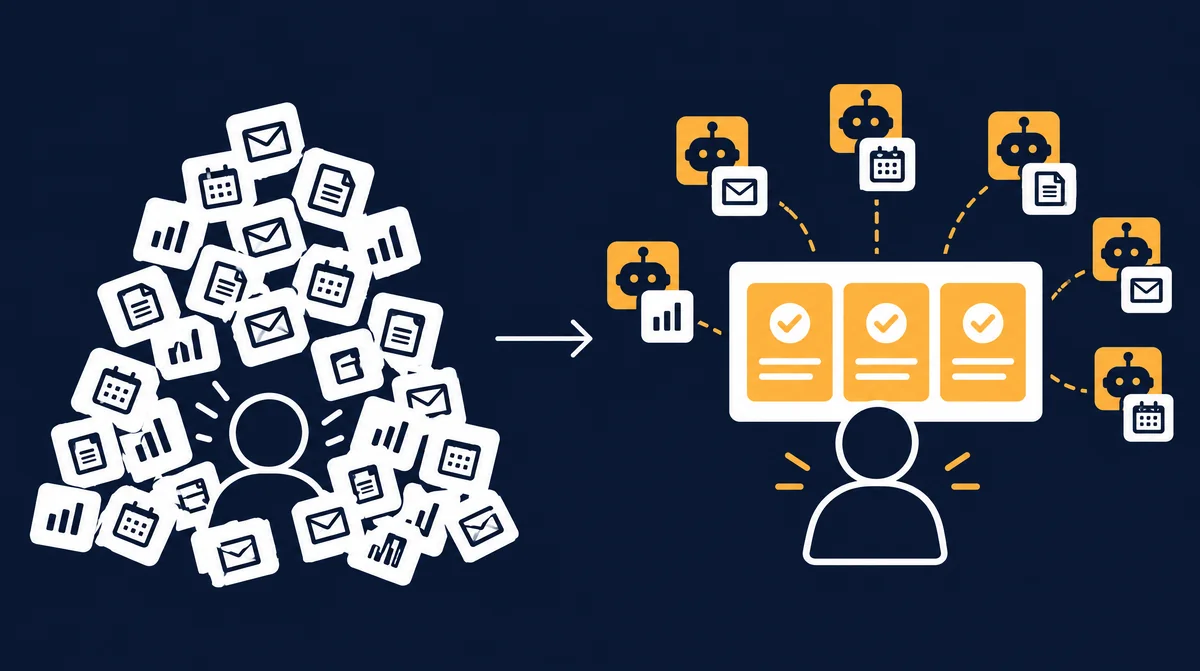
Each of these roles has two parts: a small core of decisions and a large remainder of preparation, coordination and follow-up. Nobody can or should take the core off your hands. The remainder, yes. That is the idea behind "decide instead of work": you are there for the decisions, not for collecting the information you need to make them.
What an AI assistant for CEOs can take over
The question is not whether AI can take over "management". The question is which tasks around management can be handed off. As with the org chart with AI agents, you go task by task and assign each one to one of three levels: fully AI, AI + human (AI prepares, you approve) or human.
| Task | What the AI agent does | Level | What stays with you |
|---|---|---|---|
| E-mail triage | Sorts the inbox by urgency and topic, summarises what matters, forwards routine requests to the right colleagues, drafts replies. | AI + human | Approving replies sent in your name. |
| Scheduling | Coordinates proposed times, avoids clashes, plans buffers, compiles documents for each meeting. | fully AI (by your rules) | Setting priorities: which meetings come first. |
| Follow-ups | Tracks open commitments, deadlines and replies, sends timely reminders, prepares follow-up e-mails. | fully AI | Deciding what gets followed up and what doesn't. |
| Minutes and action items | Turns meeting notes or recordings into minutes, decisions and tasks with owners, and distributes them. | AI + human | Confirming the minutes, especially decisions. |
| Decision papers | Puts options, figures, pros and cons and open questions on one page, with sources. | AI + human | The decision itself. |
| Weekly report and KPIs | Combines figures from all departments: revenue, order intake, receivables, liquidity, service tickets; comments on variances. | AI + human | Assessing, asking questions, deciding on actions. |
| Research | Pre-researches markets, competitors, suppliers and specialist topics, searches internal contracts and documents, always with sources. | fully AI | Drawing conclusions. |
| Drafts | Pre-writes letters, staff updates, presentations, statements, LinkedIn posts. | AI + human | Tone, content, approval. |
Notice that almost none of this is "fully AI" in the sense of unsupervised. Anything that goes outside or has consequences, you approve. The gain is still obvious: instead of spending twenty minutes wording an e-mail, you check a draft in two. Instead of copying figures from three systems on Friday evening, you read a finished report on Monday morning.
What stays with the CEO
A good AI executive assistant doesn't do everything. It does the right things and deliberately leaves the rest alone. What stays with you:
- Decisions: investments, prices, strategy, priorities. The agent supplies options and figures, not a decision.
- Accountability: legally and commercially, management is liable. No tool changes that (more below).
- Relationships: conversations with key customers, banks, shareholders and partners. An agent can prepare the conversation; you have to hold it.
- People decisions: hiring, dismissal, promotion, difficult conversations. AI can at most help prepare; a human always decides.
- Commitments and signatures: anything that binds your company only leaves the building with your approval.
- Leadership: giving direction, resolving conflicts, motivating people.
Not one assistant, but several specialists
Many AI assistants for executives are general-purpose tools: a chat window that can do "everything". For running a company that is not enough. A weekly report needs different knowledge and different checks than a draft reply to a customer. That's why mysoftwarelab works with a specialist pool: for each role you pick an AI specialist based on a real job profile, with domain knowledge, working rules, checklists, limits and a fixed approval rule.
Around the CEO, these specialists matter most:
- Executive assistant: sorts e-mails, coordinates meetings, prepares documents. Working rules: confidential stays confidential, ask when in doubt, draft instead of send. Checks that appointments don't overlap, documents are complete before meetings and action items from minutes are assigned. Limits: sends nothing on behalf of management without approval and makes no commitments.
- Controller: produces monthly and weekly reports, KPIs and variance analyses. Every figure with a source, assumptions disclosed, trends not presented as forecasts. Makes no investment or staffing decisions; reports reach you as drafts.
- Knowledge manager: answers questions from manuals, contracts and tickets, always with a source and only within the access rights that apply in the company.
- Legal assistant (contract review): a regulated profession, so preparatory only. Flags deviations from your template contracts and tracks deadlines, but gives no legal advice. Legal assessment stays with your lawyer.
- Purchaser: requests quotes and compares them transparently, but does not negotiate or sign.
- HR officer: a sensitive field. The specialist prepares, for example documents for conversations or deadlines, but never decides about people. Approval here is always human.
The difference from a general-purpose agent: the limits are set from the start. You don't have to explain every time what the agent may do. And for every specialist you can see who approves in the end. The full list of job profiles is under specialist pool & positions.
The cockpit as your management view: approve instead of process
Several specialists only free you up if you don't have to jump between five tools. That's why they come together in the company cockpit with AI agents. For the CEO, the cockpit is the management view of the whole company:
- All agents on the org chart: which role is staffed by which specialist, who is responsible, what got done this week?
- Approval queue: everything waiting for your decision in one place: draft replies, orders above your limit, decision papers, reports. You approve, edit or reject.
- Exceptions: whatever the agent couldn't resolve by rule doesn't get lost; it lands visibly with the responsible person.
- KPIs: figures from all departments at a glance, with comments on variances.
- Audit trail: who approved what and when? That matters not only to you but also to your duty of care.
Your role changes noticeably. You no longer work through cases; you review results and approve them. How to set the right approval levels is covered in steering and approving AI agents.
mysoftwarelab works this way itself: around 80 % of its own work is done by AI agents from its own cockpit. The managing director role is deliberately held by a human. The agents prepare, research and report; Andreas Indorf decides.
Example: a CEO's week before and after
The following is a typical week constructed as an illustration, not a measurement at a customer. It shows how work shifts when routine goes to AI specialists.
| Day | Before | After (with an AI assistant) |
|---|---|---|
| Monday | 120 unread e-mails in the morning, hunting for last week's figures in accounting and CRM. | Sorted inbox with a summary of the ten most important topics. The weekly report is ready, variances commented. |
| Tuesday | Shuffling appointments back and forth by e-mail, compiling documents for the bank meeting. | Appointments are agreed, the bank meeting pack is in the cockpit a day ahead. |
| Wednesday | Management meeting, then writing the minutes yourself or skipping them. | Minutes with decisions and tasks are ready for approval an hour later; tasks go out once approved. |
| Thursday | Comparing supplier quotes, checking contract deadlines, forgetting to chase open quotes. | Quote comparison and deadline list are ready as a draft; follow-ups remind automatically, chaser e-mails wait for approval. |
| Friday | Catching up on backlog, postponing an investment decision because documents are missing. | A decision paper with options and figures is ready. You decide instead of searching. |
The decisions in this week are the same. What changes is the time before them. How many hours that means in your case depends on your structure and can only be determined role by role.
Step by step: introducing an AI assistant for the CEO
According to KfW Research, finding first practical AI applications is a central obstacle for German mid-sized companies. For the CEO it's easier than it sounds: the applications are sitting in your own calendar. Here's how to proceed:
- Log one week: note roughly what you spend your time on. Blocks of 30 minutes are enough.
- Name your side roles: which boxes on the org chart are you quietly filling? Office, controlling, purchasing, HR, IT?
- Classify tasks: every task gets a level: fully AI, AI + human or human. Decisions, relationships and people decisions stay human.
- Choose the right specialists: for each task you can hand off, the specialist from the pool with its limits and approval rule.
- Set approval rules: what may agents do on their own (confirm meetings in free calendar slots), what only prepare (anything sent outside in your name)?
- Clarify data access: which mailboxes, calendars and systems do the agents need? Involve data protection, confidentiality and, where relevant, the works council early.
- Start with one task: usually e-mail triage or the weekly report. Review samples after two to four weeks, then expand.
Liability, data protection and the EU AI Act: what CEOs should watch
This section is not legal advice. It shows which questions to clarify with your lawyer and data protection officer. It refers to German and EU law; other jurisdictions have their own rules.
Accountability stays with you
Under Section 43 (1) of the German Limited Liability Companies Act (GmbHG), managing directors must apply "the diligence of a prudent businessman" in the company's affairs; under subsection 2, those who breach their duties are liable to the company for the damage. That doesn't mean you can't use AI. It does mean you can't hide behind an agent. When you delegate tasks, whether to people or agents, due care generally includes choosing carefully, setting clear rules and checking samples. That is exactly what specialists with fixed limits and a cockpit with approvals and an audit trail provide. How far your duties reach in an individual case is something to clarify with your lawyer.
Data protection when AI accesses your mailbox
Your inbox contains personal data of customers, suppliers and employees, often including confidential HR matters. Before an agent gets access, clarify these points:
- Data processing agreement: every provider that processes data on your behalf needs a contract under Art. 28 GDPR. At mysoftwarelab, AI services run through accounts in your name, so you control the contracts and settings yourself.
- Limit access: the agent only gets the mailboxes and folders it needs. HR mail and confidential topics can be excluded or merely flagged.
- Private use: if your company allows private use of business e-mail, stricter rules apply to employees' mailboxes. Clarify this before an agent accesses any mailbox other than your own.
- Works council: if AI systems can evaluate employees' performance or behaviour, a works council in Germany generally has co-determination rights. Involve it early.
- Data location: where is data processed and stored? More in sovereign AI and GDPR for mid-sized companies.
EU AI Act: status as of October 2026
An assistant for inbox, scheduling and reports is generally not one of the high-risk use cases under the EU AI Act. Two points still apply to you. First, AI literacy under Art. 4: it has applied since February 2025 and was softened by the Digital Omnibus (Regulation (EU) 2026/1744, in force since 27 July 2026); companies must support their staff's AI literacy but no longer guarantee a specific level. Second, transparency obligations under Art. 50, which have applied since August 2026, for example when people interact directly with an AI system. If AI systems are used for people decisions, however, the high-risk category can apply; the Omnibus postponed those obligations to December 2027. For an overview, see EU AI Act from August 2026.
Self-test: how much of your week is work, how much is decision?
Answer yes or no for a normal week:
- Do you spend more than an hour a day in your inbox?
- Do you coordinate appointments yourself by e-mail or phone?
- Do you have to pull figures from several systems yourself to know how the week went?
- Do you write minutes yourself, or are there none after meetings?
- Do you occasionally forget commitments, deadlines or follow-ups?
- Do you postpone decisions because documents are missing?
- Do you research suppliers, competitors or legal questions yourself?
- Do you write staff updates, statements or presentations from scratch?
- Do you regularly catch up on backlog in the evenings or at weekends?
- Would your company struggle to get through a week without you because much knowledge sits only with you?
Evaluation: with 0 to 3 yes answers, your week is already well focused on decisions; individual specialists can help selectively. With 4 to 6, your week contains a lot of work you could hand off, usually most of it in the inbox, the weekly report and follow-ups. From 7 upwards, you are the hidden multiple occupant of your org chart. Then it pays to go through your side roles systematically and staff them with specialists. The test is a guide, not a measurement.
Common mistakes with an AI assistant for management
- Starting with the tool instead of the tasks: first clarify what to hand off, then choose how.
- Giving the agent sending rights before trust exists: at first, everything reaches you as a draft. Relax rules only after reviewing samples.
- Bundling everything into one general-purpose assistant: weekly reports, contract deadlines and draft replies need different rules and limits.
- Forgetting the team: when agents assign tasks to colleagues, they need to know where the tasks come from and who stands behind them.
- Leaving data protection until last: mailbox and calendar access belong at the start, not the end.
Frequently asked questions about AI assistants for CEOs
What is an AI assistant for CEOs?
An AI assistant for CEOs consists of one or more AI agents that take over routine work around running the company: e-mail triage, scheduling, follow-ups, minutes, decision papers, weekly reports, research and drafts. Decisions and approvals stay with the CEO.
Can AI replace a CEO or managing director?
No. AI can prepare decisions but cannot make them or be accountable for them. Management remains legally and commercially responsible, as well as for relationships with customers, banks and shareholders and for people decisions.
Should an AI agent send e-mails on the CEO's behalf?
Technically it can, but it isn't advisable at the start. The sensible set-up: the agent writes drafts, you approve. Only clearly defined routine cases, such as meeting confirmations, can run automatically after a trial period.
Is it GDPR-compliant for AI to access the CEO's mailbox?
It can be, if there is a data processing agreement under Art. 28 GDPR, access is limited to what is needed, confidential HR matters are protected and the rules on private e-mail use are clear. Agree the set-up with your data protection officer.
Is the CEO liable for mistakes made by AI?
Under German law (Section 43 GmbHG), responsibility for the company's affairs stays with the managing director. Anyone using AI should therefore choose tools carefully, set clear rules and approvals and check samples. Clarify the details with your lawyer.
Where should a CEO start with an AI assistant?
With the task that eats the most time today and has clear rules. Usually that's e-mail triage or the weekly KPI report. After a few weeks of sample checks, follow-ups, minutes and decision papers come next.
What is an AI management cockpit?
An AI management cockpit is the central interface where management sees all AI agents on the org chart, approves results, handles exceptions and tracks KPIs from all departments.
Conclusion: decide instead of work
CEOs of mid-sized companies rarely have too few decisions, but almost always too much work around them. An AI assistant for CEOs targets exactly that: specialists take over the inbox, scheduling, follow-ups, minutes and reports, with clear limits and fixed approvals. In the cockpit you see what's waiting, what's done and where things are stuck. Accountability stays with you; you get the time for it back. If you want to approach this systematically for your whole org chart, you'll find the right packages under AI consulting.
AI assistant for CEOs
Which of your side roles can AI specialists take over?
Callback within 24 hours. Then you go through your org chart role by role with Andreas Indorf, including the boxes you fill yourself today, and see the result as a clickable prototype of your cockpit.
Request a callback → Browse the specialist poolSources
- Bitkom, press release of 14 Sept 2026: For the first time, the majority of companies use AI (German)
- KfW Research, Fokus Volkswirtschaft No. 554: Artificial intelligence in the Mittelstand (July 2026, German)
- Section 43 GmbHG: Liability of managing directors (gesetze-im-internet.de, German)
- Regulation (EU) 2016/679 (GDPR), Art. 28 Processor (EUR-Lex)
- Regulation (EU) 2026/1744 (Digital Omnibus on AI), Official Journal of the EU (EUR-Lex)
Who builds your company cockpit
Benefit from over 20 years of enterprise experience
Andreas Indorf
Managing Director, mysoftwarelab GmbH
Qualification: Founder of mysoftwarelab GmbH; with his team, builds company cockpits with AI agents for SMEs
Expertise: Over 20 years of developing and implementing IT systems for DAX companies and international corporations. Specialized in AI automation for mid-sized businesses since 2021.
Hands-on Experience: As a model operation, mysoftwarelab already runs 80% of its own IT services through AI. This hands-on experience flows directly into our client consulting.
Focus: Company cockpits in which AI agents take over recurring tasks – for companies with 5+ employees, built and run by us.
E-E-A-T Proof: All information complies with Google's E-E-A-T guidelines (Experience, Expertise, Authoritativeness, Trustworthiness) for high-quality consulting content.
Which of your tasks belong in the cockpit?
In a free callback we clarify whether a company cockpit with AI agents fits your business – for companies with 5+ employees.
- An individual company cockpit instead of single AI tools
- AI agents take over recurring tasks, your team approves
- Built and run by us – individual offer
From the lab
The most important AI news of the week – as a comic.
Every Wednesday, ByteUndGlitch explains one real AI story in eight panels. Satirical, accessible, free.
Read the latest episode