
AI Agents for Sales: Roles, Levels and Practice
In short: AI agents for sales pay off wherever work is prepared, researched, calculated and followed up: lead research, call preparation, draft quotes, CRM upkeep. The conversation itself, the negotiation and the close stay with people, because customers trust a person, not a system. The best approach is to break your sales team down role by role and task by task, and decide for each task whether it is fully AI, AI + human or human.
Sales is catching up on AI. According to Bitkom, Germany's digital industry association, 14% of German companies with 20 or more employees used AI in sales in 2026, up from 5% the year before. For comparison: 72% use AI in customer contact and 54% in marketing. Sales is late to the party, and for good reasons. It is about trust, negotiation and commitments with financial consequences. That is exactly why the question is not "AI or no AI" but: which sales task does an AI agent take over, and which one deliberately stays with a person?
This article breaks B2B sales down into its roles: lead research, setter, closer, sales support (inside sales) and key account management. Each task gets a clear classification. As an open, real-world example we use mysoftwarelab's own sales process, where setters and closers are people and AI agents handle everything around them. We also cover the legal guardrails for cold outreach and AI transparency in Germany and the EU, and the metrics you should track in your cockpit.
What AI agents can and cannot do in sales
An AI agent is more than a chatbot that writes text. It works through a task in several steps: it reads data from the CRM, researches publicly available information, applies rules, produces a result and either submits it for approval or executes it. That is what sets it apart from a classic assistant that simply answers a question.
In sales, the strengths of agents are easy to pin down:
- Research and enrichment: company profiles, industries, contacts, size, recent news. What a person pulls together in half an hour arrives as a structured brief.
- Preparation: call guide, likely challenges, relevant reference topics, open questions for the meeting.
- Documents: call notes, follow-up emails, draft quotes, order confirmations, handover summaries.
- Discipline: setting reminders, nudging on follow-up dates, finding duplicates, filling mandatory CRM fields.
- Numbers: cost calculations, margins, example ROI for the customer, forecasts based on the pipeline.
The limits are just as clear. An agent does not build trust, it does not sense when a buyer hesitates, and it carries no responsibility for a commitment. If you hand your entire sales process to agents, you may save time, but you lose what closes deals in B2B: a person the customer believes will keep their word.
Why sales is deliberately not fully AI
In many parts of a company, a task can go entirely to an agent, for example answering calls or replying to recurring customer questions. In sales, there are three reasons to keep the human role on purpose:
- Trust is personal. In B2B, a company often buys for years. The customer wants to know who stands behind the quote and whom to call when something goes wrong.
- Negotiation needs judgement. Whether a discount makes sense, whether a project is getting too big, whether a customer really fits: these are trade-offs with consequences for margin, capacity and reputation.
- Commitments carry liability. Quotes, delivery times and special terms bind your company. That requires a person with authority.
None of this means AI in sales is not worth it. Quite the opposite: if your salespeople spend most of their time on research, documents and CRM upkeep, they spend too little time talking to customers. Agents give that time back. The logic follows the three-level principle from our guide Org chart with AI agents: the level applies to the task, not to the whole position.
Sales roles broken down: task by task
The table below shows typical B2B sales tasks and a sensible classification. It is a starting point, not a rule. Depending on product, deal size and customer base, some tasks will shift.
| Role | Task | Level | Reason |
|---|---|---|---|
| Lead research | Find target companies matching the customer profile | Fully AI | Rule-based, public business data, errors can be corrected. |
| Lead research | Enrich contacts, check duplicates, assign a lead score | Fully AI | Recurring, clear checklist, source for every record. |
| Lead research | Define target group and outreach | AI + human | Strategic decision, legal constraints. |
| Setter | Prepare company profile and call guide | Fully AI | Pure preparation, nothing goes outside. |
| Setter | First contact, qualify needs, book the meeting | Human | First impression, trust, legally sensitive. |
| Setter | Meeting confirmation and reminder | Fully AI | Standard message to prospects who have already agreed. |
| Closer | Meeting prep, draft org chart, example ROI | AI + human | Agent drafts, closer reviews before the meeting. |
| Closer | Consultation, negotiation, closing | Human | Trust, judgement, responsibility. |
| Closer | Call notes and follow-up draft | AI + human | Agent writes, closer approves. |
| Sales support | Qualify and answer inquiries | AI + human | Standard cases by the agent, special cases to a person. |
| Sales support | Prepare quotes | AI + human | Below a threshold by rules, above it with approval. |
| Sales support | Order confirmations, follow-ups, CRM upkeep | Fully AI | Clear rules, data from the system, high repetition. |
| Key account | Customer history, renewals, early warning signs | Fully AI | Analysis and alerts, no decisions. |
| Key account | Annual review, upselling, cancellation talks | Human | Relationship and negotiation. |
The pattern is striking: everything that happens before and after a conversation suits agents. The conversation itself stays human. Breaking sales down this way takes a lot of load off your team without putting a robot in front of your customer.
Role by role: what the AI agent actually does
Lead research: the agent as researcher
AI lead generation is the entry point with the clearest benefit. The agent receives your ideal customer profile (industry, size, region, triggers such as growth or new locations) and looks for matching companies. For each company it creates a record with its source, checks for duplicates in the CRM and assigns a justified score. The limits matter: only publicly available business data, no private data, no marketing emails without consent. That is how these rules are built into the "Lead researcher" in our specialist pool; the sales team approves target group and outreach.
Setter: a person on the phone, an agent in the background
The setter qualifies prospects and books the meeting. This role stays human because it shapes the first impression. Before each contact, the agent provides a brief: what does the company do, how is it set up, which questions are likely? After the contact, it writes the note into the CRM, sends the confirmation and reminder and sets the next follow-up. The setter talks, the agent does the paperwork.
Closer: consultation and closing with full preparation
The closer leads the consultation and negotiates. They should walk into every meeting with the full picture: company profile, decision structure, likely bottlenecks, a transparent example calculation. An agent can prepare all of that. After the meeting it drafts the follow-up and the quote. The closer reviews, edits and approves. What the agent does not do: promise discounts, sign contracts or "argue away" customer concerns.
Sales support: the biggest lever
In many SMEs, sales support (the inside sales back office) is where the biggest block of time sits: answering inquiries, writing quotes, sending order confirmations, following up, updating the CRM. This is where AI quote generation fits best, as long as it has clear rules. The "Sales support" specialist in the pool works like this:
- Expertise: your product range, price lists and terms, CRM maintenance and follow-ups, quote structure.
- Working rules: prices only from the current price list, discounts only within the approved range, every inquiry answered the same day.
- Checklist: quote complete with items, delivery time and validity; customer and contact in the CRM; follow-up date set.
- Limits: no special terms outside the range, signs no contracts, complaints involving goodwill go to a person.
- Approval rule: sales approves quotes above your threshold.
For more complex quotes, other specialists support the team: the "Cost estimator" calculates from materials, labour time and mark-ups and never goes below the minimum margin. The "Tender manager" finds suitable public tenders and prepares bid documents; management decides on participation and submission.
Key account: relationship with people, early warning from agents
With existing customers, continuity counts. The "Customer success manager" specialist keeps renewal dates, open tickets and usage in view and reports warning signs immediately. No discounts without approval, and cancellation conversations are led by people. The key account manager walks into every annual review with an up-to-date customer file, without having to compile it.
Real-world example: how mysoftwarelab runs its own sales
mysoftwarelab uses the model itself. AI agents from its own cockpit handle around 80% of the company's work. Back office and phone, marketing, and support and knowledge run fully on AI. Sales, on the other hand, is deliberately classified as AI + human. The process:
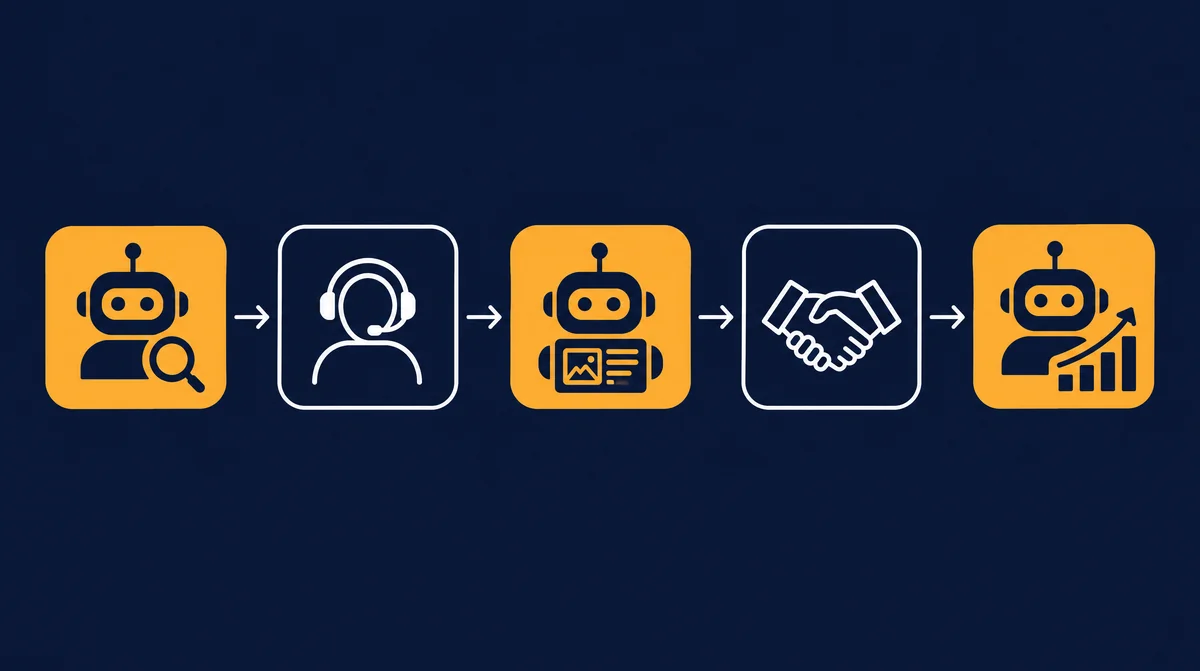
- Research and qualify leads: agents find matching companies, enrich them and prioritise them in the CRM.
- Callback within 24 hours: a person responds to every inquiry. The agent has prepared the company profile beforehand.
- Prepare the first meeting: an agent drafts a first org chart from the prospect's website. In the meeting, a person walks through it role by role with the customer and gathers all the information.
- Build the prototype: after the first meeting, an agent builds a clickable prototype of the customer's individual cockpit and an example calculation of the potential benefit.
- Second meeting: a person presents the prototype, answers questions and negotiates.
- Follow-up: agents write the follow-up and draft quote, update the CRM and set reminders. People approve.
Setters and closers are people. The agents make sure those people spend almost all their time in conversations rather than on research, building presentations or admin.
Example calculation: time saved in sales support
Whether AI agents for sales pay off depends on your numbers. A simple example calculation with disclosed assumptions helps. The figures are explicitly assumed, not measured.
- Assumption 1: your sales support team writes 25 standard quotes per week.
- Assumption 2: a quote currently takes 45 minutes (read the inquiry, look up items, check terms, write, update the CRM).
- Assumption 3: with an agent's draft, 10 minutes remain for review and approval.
Today: 25 × 45 minutes = about 18.8 hours per week. With the agent: 25 × 10 minutes = about 4.2 hours. Calculated time saved: roughly 14.6 hours per week, almost two working days. Whether that time goes into more follow-ups, faster replies or more customer meetings is up to you. Plug in your own figures; a solid calculation per role with hours and costs is part of an org chart analysis. More examples of benefit calculations are in our article AI agents: use cases and ROI.
Legal guardrails: cold outreach and AI transparency
Sales automation calls for care, because an agent can generate a very large number of contacts in a short time. The following points refer to Germany and the EU. They are guidance, not legal advice; consult a lawyer for individual cases.
- B2B phone calls in Germany: under Section 7(2) no. 1 of the German Act against Unfair Competition (UWG), an advertising call to a business is only permitted with at least its presumed consent. The Chamber of Industry and Commerce (IHK) points out that this requires a specific, factual connection to the business of the person called. A phone number on a website or a general, theoretical interest is not enough. The caller bears the risk of misjudging.
- B2B email in Germany: under Section 7(2) no. 2 UWG, advertising by email without prior express consent is not permitted, including to businesses. A narrow exception in Section 7(3) UWG covers existing customers: the company's own similar goods or services, no objection, and a clear notice of the right to object when the address is collected and every time it is used.
- Automated calling machines: Section 7(2) no. 2 UWG also requires prior express consent here. An AI agent that places sales calls on its own is therefore not a way around the rules for cold outreach.
- AI transparency: the transparency obligations under Article 50 of the EU AI Act have applied since 2 August 2026. Article 50(1) requires AI systems that interact directly with people to be designed so that the person learns they are dealing with an AI, unless that is obvious. If you use agents with direct customer contact, for example in chat or on the phone, customers should be able to tell. For machine-readable marking of AI-generated content, systems already on the market before 2 August 2026 have a transition period until 2 December 2026. More in our article EU AI Act from August 2026.
- Data protection: business contacts are personal data too. Store the source for each record, delete what you do not need and act on objections immediately.
The practical consequence for the model in this article: first contact stays with a person, and agents only send messages to people who have consented or are already in a conversation. These rules do not belong in individual employees' heads but in the agent's fixed working rules.
Trust stays with people: setting approvals right
For "AI + human" to work day to day, every task needs a clear approval rule. Three types have proven useful:
- Threshold: quotes up to a certain amount go out by rules; above it, sales approves.
- Sampling: for routine work such as order confirmations, a person regularly checks a share.
- Always approve: anything containing a new commitment, such as special terms, individual delivery times or contract changes.
How to set up approval levels and lead agents day to day is covered in our guide Steering and approving AI agents. Towards the customer, one thing holds: when a quote is approved and signed by a person, that person stands behind it. That is the core of the trust you should not hand to a machine.
Metrics in the cockpit: what to track
In the company cockpit you steer, approve and monitor the agents of every role in one place. For sales, these metrics are particularly telling:
| Metric | What it shows |
|---|---|
| Response time to inquiries | How fast an inquiry is answered. Target of the sales support specialist: same day. |
| Qualification rate | Share of researched leads that turn into a conversation. Shows whether the customer profile is right. |
| Meetings per setter per week | Whether the time saved actually goes into conversations. |
| Quote rate and win rate | From first meeting to quote, from quote to order. |
| Quote turnaround time | Time from inquiry to quote sent. |
| Open quotes without follow-up | Should be zero. Every quote without a follow-up date is revenue left on the table. |
| Edit rate of agent drafts | How often people need to change drafts substantially. If it rises, rules or data need sharpening. |
| Approval backlog | If the agent is waiting for a person, the system loses its advantage. |
| CRM data quality | Duplicates, missing mandatory fields, outdated contacts. |
| Objections and unsubscribes | Early warning for outreach that is too aggressive or legally risky. |
Bitkom president Ralf Wintergerst sums up the prerequisite: an agent that acts on its own needs reliable data, connected systems and rules. In sales that means a well-kept CRM, a current price list and clear approval thresholds.
How to introduce AI agents in sales
- Map sales roles: who handles research, first contact, consultation, quotes, follow-ups and account management today? Include tasks done "on the side".
- Classify tasks: fully AI, AI + human or human for each task. The table above is a good starting point.
- Quantify effort: hours per week per task. Start where most hours go into preparation and admin.
- Provide data: clean up the CRM, keep price lists and terms current, define quote templates.
- Choose specialists and set rules: the right specialist per role from the pool, plus thresholds, discount ranges and legal rules for outreach.
- Start with one role: usually sales support or lead research. Observe for four weeks, evaluate the edit rate, sharpen the rules.
- Expand: add the next role only once the first one runs smoothly.
If you would like guidance along the way, you will find our packages on the AI consulting page.
Frequently asked questions about AI agents for sales
What do AI agents do in sales?
AI agents for sales research and qualify leads, prepare meetings, write call notes, follow-ups and draft quotes, set reminders and keep the CRM up to date. Conversations, negotiation and closing sensibly stay with people.
Can AI replace the sales team entirely?
Many individual tasks can be automated, but a fully automated sales process rarely makes sense in B2B. Customers trust people, negotiations need judgement and commitments need someone who stands behind them. A split by task works better: agents prepare and follow up, people lead the conversations.
What is an AI SDR?
An AI SDR (sales development representative) is an AI agent that takes over sales development tasks: finding, enriching and prioritising leads and preparing outreach. In Germany, Section 7 UWG applies, so first contact by phone or email needs careful checking.
Can an AI agent do cold outreach by email or phone?
Under German law (Section 7 UWG), advertising emails generally require prior express consent, even in B2B. Advertising calls to businesses require at least presumed consent, and automated calling machines require express consent. In addition, the EU AI Act transparency obligations have applied since 2 August 2026. Have your approach checked legally for your specific case.
Which sales task is the best place to start?
Usually sales support or lead research. Both involve many recurring tasks, clear rules and results that can be reviewed before anything goes out.
What data does an AI sales assistant need?
A well-kept CRM with customers, contacts and history, current price lists and terms, quote templates, a clear ideal customer profile and defined approval thresholds. The better these foundations, the less people need to correct.
How do I know whether AI agents are working in sales?
Through metrics such as response time to inquiries, meetings per setter, quote turnaround time, win rate and the edit rate of agent drafts. Track these continuously in your cockpit.
Conclusion: agents prepare, people win customers
AI agents for sales are strongest when they clear the way for people: research, preparation, quotes, follow-ups and CRM. The conversation, the negotiation and the responsibility for commitments deliberately stay human. Break your sales team down role by role, choose the right level for each task and lead the agents in the cockpit with clear approvals, and you gain time for what counts in B2B: talking to customers.
AI agents for sales
More time for customer conversations: your sales team with AI agents.
Callback within 24 hours. Then you go through your sales roles task by task with Andreas Indorf and see in a clickable prototype of your cockpit where agents prepare and where your people decide.
Request a callback → Browse the specialist poolSources
- Bitkom, press release of 14 September 2026: For the first time, a majority of companies use AI (German)
- Section 7 UWG (Unacceptable nuisance), gesetze-im-internet.de (German)
- IHK Karlsruhe: Advertising by phone, email and letter – what is allowed? (German)
- Regulation (EU) 2024/1689 (AI Act), Article 50, EUR-Lex
- European Commission: FAQ on the Code of Practice on transparency of AI-generated content
Who builds your company cockpit
Benefit from over 20 years of enterprise experience
Andreas Indorf
Managing Director, mysoftwarelab GmbH
Qualification: Founder of mysoftwarelab GmbH; with his team, builds company cockpits with AI agents for SMEs
Expertise: Over 20 years of developing and implementing IT systems for DAX companies and international corporations. Specialized in AI automation for mid-sized businesses since 2021.
Hands-on Experience: As a model operation, mysoftwarelab already runs 80% of its own IT services through AI. This hands-on experience flows directly into our client consulting.
Focus: Company cockpits in which AI agents take over recurring tasks – for companies with 5+ employees, built and run by us.
E-E-A-T Proof: All information complies with Google's E-E-A-T guidelines (Experience, Expertise, Authoritativeness, Trustworthiness) for high-quality consulting content.
Which of your tasks belong in the cockpit?
In a free callback we clarify whether a company cockpit with AI agents fits your business – for companies with 5+ employees.
- An individual company cockpit instead of single AI tools
- AI agents take over recurring tasks, your team approves
- Built and run by us – individual offer
From the lab
The most important AI news of the week – as a comic.
Every Wednesday, ByteUndGlitch explains one real AI story in eight panels. Satirical, accessible, free.
Read the latest episode