
AI in Marketing: Staffing Your Marketing Team with AI
In short: AI in marketing pays off most when you stop adding individual tools and start staffing the positions of your marketing team with AI specialists: content, SEO, social media, performance, email, analytics and design. AI can take over many tasks completely, such as drafts, reports and ad variants. Brand voice, advertising claims and budgets stay tied to fixed human approvals, steered and monitored in one cockpit.
Marketing is the second most common area where companies use AI. According to Bitkom, Germany's digital industry association, 57 % of German companies use AI in 2026 for the first time, and 54 % of those companies use it in marketing and communication. Only customer contact ranks higher, at 72 %. The same survey also finds that no company is using AI to its full potential, and 59 % are nowhere near it.
The reason is rarely the technology. KfW Research, too, names finding the first practical applications as a key obstacle for German SMEs. Usually one person on the team writes copy with a chat tool, another generates images, and the ad platform optimises automatically anyway. That saves an hour here and there but does not change how the team works. This guide takes a different route: you look at your marketing team as an org chart, decide position by position and task by task what AI takes over, and define where a human approves.
AI in marketing: why tools alone are not enough
Most guides on AI in marketing are tool lists: one app for copy, one for images, one for social scheduling. That is a fine start, but it leads to three typical problems:
- Silos: each tool only sees its own slice. The copy generator knows nothing about campaign results, the ad tool nothing about your brand voice.
- Unclear accountability: who checks whether the figure in a LinkedIn post is correct? Who decides whether an AI image needs a label? Without ownership, in doubt nobody checks.
- No measurement: if AI is only used "on the side", nobody knows how many hours it saves or whether results get better or worse.
The org chart approach solves this by turning the question around. Instead of "Which tool should we use?" you ask: "Which position in our marketing do we staff with which AI specialist, and who approves its output?" Our guide to the org chart with AI agents explains the basic method.
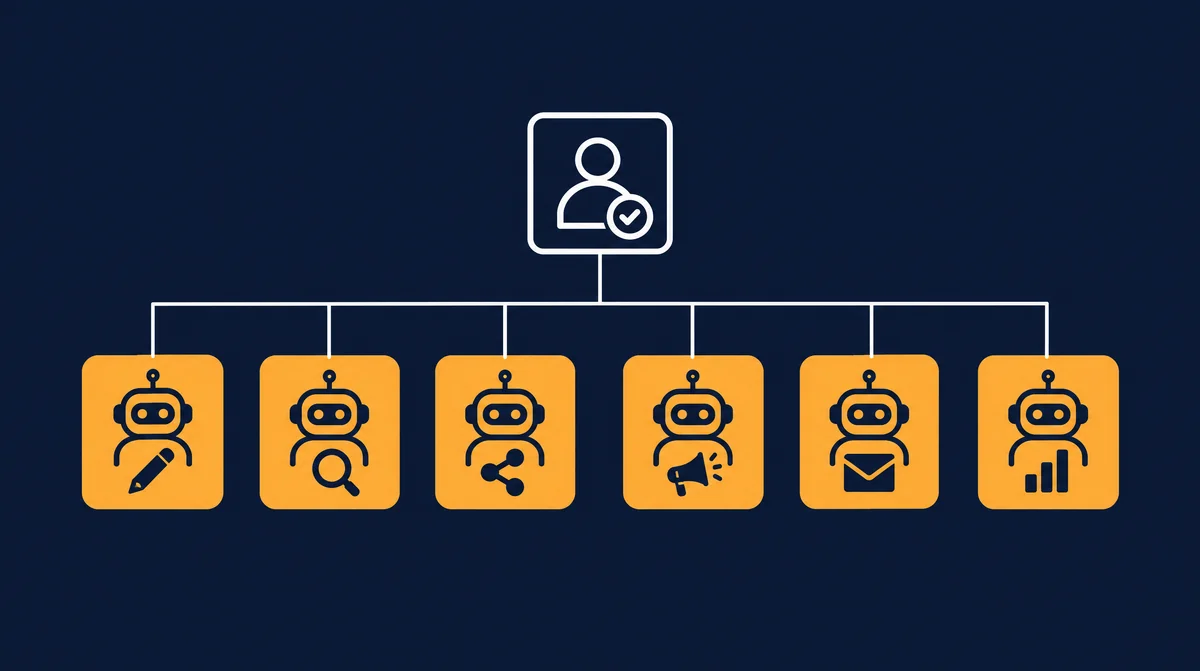
The AI marketing team: seven positions in the org chart
A typical marketing team in a mid-sized company rarely has seven people. Often one person does everything, supported by an agency. The tasks exist anyway. That is why it helps to think of them as positions, even if nobody formally holds them today. For each position, the mysoftwarelab specialist pool has a matching job profile with its own expertise, working rules, checklists, limits and a fixed approval rule.
| Position | Typical tasks | What the specialist must not do | Approval rule |
|---|---|---|---|
| Content editor & copywriter | Blog articles, landing pages, product copy, newsletter copy | Publish anything without approval; invent quotes, figures or testimonials | Every text is approved before publication. |
| SEO manager (incl. AI search) | Keyword and topic research, technical SEO, structured data, visibility in AI answers | Publish pages without approval; buy links; guarantee rankings | Marketing approves new pages and larger changes. |
| Social media manager | Content calendar, posts for LinkedIn, Instagram and others, community management | Comment on crises, politics or legal matters; answer complaints without a human | A human approves the content calendar and sensitive replies. |
| Performance marketing manager | Ads on Google, Meta and LinkedIn, bidding strategies, creative testing | Raise budgets or launch new campaigns without approval; make unsupported promises | A human approves budgets and new campaigns. |
| Email & CRM marketing manager | Newsletters, automated email sequences, CRM segmentation | Send marketing emails without consent, not even to companies; use purchased lists | Every send to a new list is approved. |
| Data analyst | Analyses from CRM, website and ad accounts, dashboards, monthly reports | Make decisions from forecasts without a human; analyse individual employees | Reports go to those responsible; people make the decisions. |
| Graphic designer | Ad visuals, social graphics, presentations, image editing | Depict real people without consent; imitate other brands or works | Marketing approves visuals. |
Depending on the company, further positions join: a video producer for explainers and reels, a PR and press officer, translation and localisation for export markets. All of these specialists run at the "standard operation" level in the pool: they work on their own, but approval follows fixed rules, thresholds and spot checks. You can browse the full job profiles under specialist pool and positions.
Tasks by level: what AI handles fully and what needs approval
The level applies to the individual task, not to the whole position. An SEO position can have rankings monitored entirely by AI while every new landing page is approved. The table below shows a typical classification. It is a starting point, not a rule: your own classification depends on your industry, risk and maturity.
| Task | Fully AI | AI + human | Human |
|---|---|---|---|
| Topic research, keyword analysis, competitor monitoring | Yes | ||
| Writing blog articles, landing pages, newsletters | AI writes, human approves | ||
| Publishing social posts from the approved content calendar | Yes, once the plan is approved | ||
| Replying to comments and criticism | Routine questions | Criticism and complaints | Crisis communication |
| Testing ad variants, adjusting bids | Yes, within budget | ||
| Raising budgets, launching new campaigns | AI proposes, human decides | ||
| Email sequences to existing lists | Yes, once the sequence is approved | ||
| Graphics and ad visuals | AI designs, marketing approves | ||
| Monthly report and dashboard | Yes | ||
| Positioning, brand strategy, choice of agencies and tools | Yes, AI supplies analyses |
A pattern emerges: fully AI is whatever stays internal or happens within limits approved in advance. AI + human applies wherever something goes out for the first time or costs money. Strategy, stance and accountability stay with people. Read more about approval levels in steering and approving AI agents.
Where approvals sit: brand voice, claims, budgets
"Marketing runs fully on AI" does not mean nobody looks any more. It means people no longer carry out every task themselves but decide at a few clearly defined points. Three approval points are essential in marketing:
1. Brand voice
People define the brand voice once: tone, form of address, banned words, spellings, example texts. Every specialist receives these rules. Approval is intensive at first and later done by spot check. Only when the correction rate stays low over time do you relax approval for routine formats.
2. Advertising claims
Every statement about products, services, results or competitors needs evidence. AI models write convincingly even when a number is wrong. So the rule is: a human always approves new claims, and specialists may only use statements from an approved claims list with sources.
3. Budgets
The performance specialist may optimise within a set frame: bids, variants, audiences. Every budget increase and every new campaign goes into the cockpit as a proposal with reasoning, and a human decides. Control over spending stays where it belongs.
Case in point: marketing at mysoftwarelab runs fully on AI
mysoftwarelab uses its own model. Around 80 % of its own work is done by AI agents from its own cockpit. Marketing is one of the areas that run entirely at the "fully AI" level, alongside back office and phone as well as support and knowledge. In practice this means:
- Content and SEO: agents handle topic research, article drafts in German and English, structured data and internal linking. Facts are backed by sources, and testimonials are never invented.
- Social media and video: posts come from a content calendar, images and videos from AI tools. Synthetic voices and avatars are labelled.
- Ads: agents test variants and evaluate which campaigns bring qualified enquiries, not just clicks.
- Approvals: management has set the brand voice, positioning and budget frame. New claims and budget changes land in the cockpit for approval.
The line to sales matters: there, mysoftwarelab works at the AI + human level. Setters and closers are people; AI researches leads, builds prototypes and calculates ROI. Marketing creates attention and enquiries, sales holds the conversations. The article on AI agents in sales describes the handover between the two.
Legal points: labelling, copyright, claims, data protection
Several areas of law meet in AI marketing. The overview below focuses on the EU and Germany. It is not legal advice, but it shows where your approval rules should apply. Status: October 2026.
Labelling AI-generated content (Art. 50 EU AI Act)
The transparency obligations under Art. 50 of the EU AI Act have applied since 2 August 2026. The Digital Omnibus published in July 2026 did not postpone them in principle. According to law firms, generative AI systems already on the market before 2 August 2026 only get a transition period until 2 December 2026 for machine-readable marking, which is an obligation of the system providers.
For you as a company using AI in marketing (a "deployer" in the regulation's terms), two duties are especially relevant:
- Deepfakes: if you generate or manipulate image, audio or video content with AI that resembles real people, places or events and could falsely appear authentic, you must disclose that it is artificially generated. For evidently artistic or fictional works, a notice that does not disrupt the work is enough.
- Text on matters of public interest: AI-generated text published to inform the public on such matters must be disclosed, unless a human has reviewed it editorially and someone holds editorial responsibility.
In practice: ordinary ad copy and blog articles that a human reviews before publication are generally not subject to labelling under Art. 50. Realistic AI images and videos of people are. The European Commission is working on a code of practice and guidelines to clarify the details. Platforms such as LinkedIn or Meta also have their own labelling rules. For the wider framework, see the EU AI Act from August 2026.
Copyright in AI images
Under German law, purely AI-generated images and logos are generally not protected by copyright because a human's own intellectual creation is missing. The Chamber of Commerce (IHK) Koblenz refers to a ruling by the Munich Local Court of 13 February 2026 (ref. 142 C 9786/25). The consequence for marketing: competitors may be able to use an AI visual without you being able to stop them. For logos and core brand assets, human design or documented human rework is advisable, plus trademark or design protection where appropriate. Also check the terms of use of each AI tool.
Advertising claims (German Unfair Competition Act, UWG)
AI copy is subject to the same rules as human copy: misleading advertising is prohibited no matter who wrote it. Since 27 September 2026, stricter rules on environmental claims from EU Directive 2024/825 also apply in Germany: generic terms such as "eco-friendly" or "green" are not allowed without proof of recognised excellent environmental performance. An AI copywriter that sprinkles in such words "for flavour" is a real risk. That is why a claims list and a list of banned words belong in every specialist's working rules. For email advertising, Section 7 UWG generally requires prior express consent.
Data protection for tracking and personalisation
Tracking pixels and cookies that are not technically necessary require consent under Section 25 of the German TDDDG; processing the data is governed by the GDPR. A performance agent optimising on conversion data may therefore only work with data covered by consent. If AI services process personal data from your CRM, you also need a data processing agreement with the provider. Choose models and hosting so that data stays within a framework you control.
The new search landscape: visibility in AI Overviews and ChatGPT (GEO)
More and more searches are no longer answered with ten blue links alone but with an AI summary, in Google's AI Overviews or in assistants such as ChatGPT. Optimising for this is often called GEO (generative engine optimisation). Google itself states that there are no additional requirements or special optimisations needed to appear in AI Overviews. A page must be indexed and eligible to be shown with a snippet; the familiar SEO fundamentals still apply.
This translates into clear working rules for the SEO specialist:
- The answer belongs at the top of an article, not in the fifth paragraph.
- Important content is on the page as text, not only in images or PDFs.
- Structured data must match the visible content.
- Sourced facts, first-hand experience and concrete examples set your page apart from generic text.
- Measure both: classic rankings and whether your brand appears in AI answers on your core topics.
KPIs in the cockpit: how to steer your AI marketing team
In the company cockpit, the person in charge sees not only marketing figures but also how well the AI specialists are performing. Two groups of KPIs have proven useful:
| Outcome KPIs | Steering KPIs for the AI specialists |
|---|---|
| Qualified enquiries per month | Open approvals and average waiting time |
| Cost per qualified enquiry | Correction rate: share of drafts that had to be changed |
| Organic traffic and rankings for core topics | Rejected claims and reasons |
| Mentions in AI answers on core topics | Spend on AI services per specialist |
| Newsletter open, click and unsubscribe rates | Escalations to people, e.g. critical comments |
The steering KPIs are the real lever. If the correction rate falls over several weeks, you can switch approvals to spot checks. If it rises, something is wrong with the rules or the data. The cockpit keeps all of these figures in one place, together with open approvals.
Six steps to an AI marketing team
- Capture tasks: list every marketing task from the last three months, including those handled by agencies or by management on the side. Estimate hours per week.
- Form positions: assign the tasks to positions: content, SEO, social media, performance, email, analytics, design. Empty positions are fine; they reveal gaps.
- Set a level per task: fully AI, AI + human or human. Rule of thumb: anything that goes outside or costs money starts with approval.
- Build the foundations: brand voice, claims list with sources, banned words, budget frame, image rights rules. Without these, no specialist works reliably.
- Deploy and connect specialists: choose the matching specialist from the pool for each position and connect CMS, CRM, ad accounts and newsletter system so the agents work with real data.
- Run approvals in the cockpit and relax them: start tight, measure correction rate and results, and relax approvals only where the numbers justify it.
At mysoftwarelab you go through these steps together in the first meeting: your org chart is prepared in advance based on your website, discussed role by role in the meeting, and turned into a clickable prototype of your cockpit. If you want more detail first, a Company Org Chart Analysis quantifies the AI potential per role in hours and costs. The packages for long-term support are listed under AI consulting.
Common mistakes with AI in marketing
- Mass production without strategy: AI makes it easy to produce lots of content. More content without a clear audience and positioning does not bring enquiries.
- Invented evidence: figures, studies or testimonials the model adds because they "fit". Rule: no number without a verified source.
- Undefined brand voice: without written rules, every text sounds like generic AI and interchangeable.
- Optimising for clicks: ad automation without feedback from sales optimises for cheap but poorly fitting contacts.
- Forgetting labels and image rights: realistic AI images of people without a notice, or visuals that imitate other people's work.
FAQ: AI in marketing
How can I use AI in marketing in practice?
Most effectively by assigning your marketing tasks to positions (content, SEO, social media, performance, email, analytics, design) and deciding for each position what AI handles fully and where a human approves. Typical starting points are topic research, copy drafts, ad testing and monthly reports.
Can AI replace an entire marketing team?
AI can take over a large share of the hands-on work. At mysoftwarelab, marketing runs fully on AI agents. Strategy, positioning, brand voice, new claims and budgets still stay with people. Without these approvals, legal and commercial risk rises sharply.
Does AI-generated marketing content have to be labelled?
Under Art. 50 of the EU AI Act, deepfakes in particular must be disclosed since 2 August 2026: AI images, videos or audio that resemble real people, places or events and could appear authentic. AI-generated text on matters of public interest must also be disclosed unless it has been editorially reviewed and someone holds responsibility. Platforms have additional rules. Seek legal advice for individual cases.
Are AI-generated images protected by copyright?
In Germany, purely AI-generated images are generally not protected by copyright because human creation is missing. For logos and core brand assets, human design and, where appropriate, trademark or design protection make sense.
How do I become visible in AI Overviews and ChatGPT?
According to Google, there is no special optimisation for AI Overviews. What matters are SEO fundamentals: indexable pages, the answer up front, content as text, matching structured data and sourced, concrete content.
Is AI in marketing worth it for small and mid-sized companies?
Especially in mid-sized companies, where one person often runs all of marketing, AI can fill missing positions. Whether it pays off becomes clear from a list of today's hours per task and the level AI can take over in each case.
Which KPIs should I monitor for AI in marketing?
Outcomes such as qualified enquiries and cost per enquiry, plus steering figures for the AI: open approvals, correction rate, rejected claims, cost of AI services and escalations to people.
Conclusion: structure first, then tools
AI in marketing is already everyday practice: more than half of the companies using AI apply it there. The difference lies in whether AI is used on the side or whether every marketing position is deliberately staffed, with a specialist, clear limits and a fixed approval. Keep brand voice, claims and budgets in human hands, measure outcomes and correction rate in the cockpit, and widen AI's scope step by step.
AI in marketing
Staff your marketing team with AI specialists – position by position.
Callback within 24 hours. Then you go through your marketing role by role with Andreas Indorf – with a clickable prototype of your cockpit and clear approvals for brand voice, claims and budgets.
Request a callback → Browse the specialist poolSources
- Bitkom: For the first time, the majority of companies use AI (press release, 14 Sep 2026, German)
- KfW Research, Fokus Volkswirtschaft No. 554: AI in SMEs (July 2026, German)
- EUR-Lex: Regulation (EU) 2024/1689 (AI Act), Art. 50
- European Commission: Code of Practice on transparency of AI-generated content
- Garrigues: AI Digital Omnibus Regulation published (deadlines and transition rules)
- IHK Koblenz: Legal aspects of AI-generated logos (German)
- EUR-Lex: Directive (EU) 2024/825 (empowering consumers for the green transition)
- Ebner Stolz: EmpCo Directive applies from 27 Sep 2026 (German)
- Section 7 UWG: unacceptable nuisance (German)
- Section 25 TDDDG: protection of privacy in terminal equipment (German)
- Google Search Central: AI features and your website
Who builds your company cockpit
Benefit from over 20 years of enterprise experience
Andreas Indorf
Managing Director, mysoftwarelab GmbH
Qualification: Founder of mysoftwarelab GmbH; with his team, builds company cockpits with AI agents for SMEs
Expertise: Over 20 years of developing and implementing IT systems for DAX companies and international corporations. Specialized in AI automation for mid-sized businesses since 2021.
Hands-on Experience: As a model operation, mysoftwarelab already runs 80% of its own IT services through AI. This hands-on experience flows directly into our client consulting.
Focus: Company cockpits in which AI agents take over recurring tasks – for companies with 5+ employees, built and run by us.
E-E-A-T Proof: All information complies with Google's E-E-A-T guidelines (Experience, Expertise, Authoritativeness, Trustworthiness) for high-quality consulting content.
Which of your tasks belong in the cockpit?
In a free callback we clarify whether a company cockpit with AI agents fits your business – for companies with 5+ employees.
- An individual company cockpit instead of single AI tools
- AI agents take over recurring tasks, your team approves
- Built and run by us – individual offer
From the lab
The most important AI news of the week – as a comic.
Every Wednesday, ByteUndGlitch explains one real AI story in eight panels. Satirical, accessible, free.
Read the latest episode