AI Phone Receptionist: Features, Limits & EU Rules
In short: An AI phone receptionist answers calls around the clock in natural language, works out what the caller needs, books appointments, gives status updates from your systems and logs a call note in your CRM. Anything it must not or cannot handle, such as complaints, emergencies or key accounts, it hands to a person according to fixed rules. In the EU, callers must be told they are talking to an AI since 2 August 2026, and recording a call requires consent.
In many businesses the phone is where the most work gets lost without anyone measuring it. Calls arrive in bursts, usually when everyone is in a meeting, in the workshop or out with a customer. If nobody picks up, you lose enquiries; if someone does, they are pulled away from their actual work. At the same time, reception is the position that can most often be filled entirely by AI: conversations follow recurring patterns, the information needed is usually digital, and mistakes can be caught by a clean handover to a person.
The latest Bitkom survey of German companies shows that this is exactly where businesses start. Among companies using AI, customer contact is the most common area of use at 72%, well ahead of marketing and communications at 54%. This guide explains what an AI phone receptionist can actually do today, where its limits are, what the law requires in the EU and Germany, and how to introduce one so that it takes work off your team instead of creating more.
What is an AI phone receptionist?
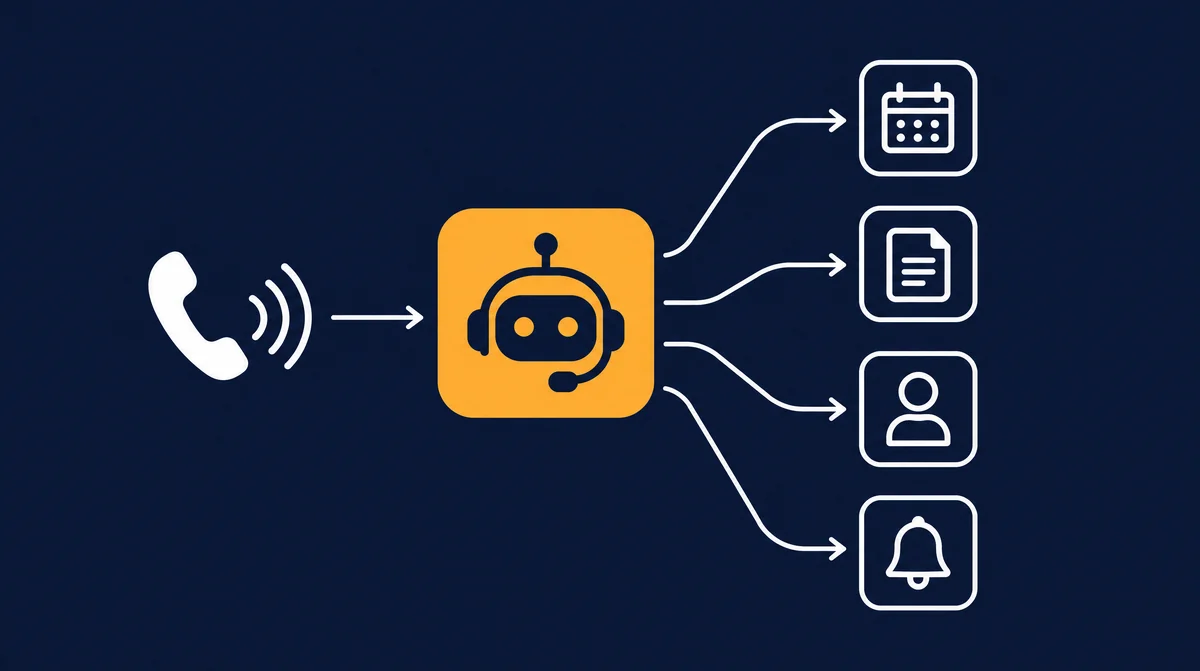
An AI phone receptionist (also called an AI receptionist, AI answering service or AI voice agent for business) is a voice agent that handles inbound calls on its own. Three components work together: speech recognition turns what is said into text, a language model understands the request and decides on the next step, and a synthetic voice replies. What makes it useful is a fourth component: integration with your systems, such as calendar, CRM, ERP or ticketing. Only then can it do more than talk: it can enter appointments, look up order status and create callback tasks.
It is fundamentally different from a classic phone menu ("press 1 for …"). Callers describe their issue in their own words, even if they jump around or ask questions back, and the assistant steers the conversation to an outcome. It differs from a simple chatbot in that it acts: it is an AI agent with clearly limited permissions. The article Agentic AI vs. chatbots explains the difference between dialogue systems and acting agents in more detail.
What an AI phone receptionist can do today
Performance depends less on the language model than on which systems are connected and which rules are in place. Set up properly, an AI phone receptionist typically takes on these tasks:
- Answer calls 24/7: outside business hours, during lunch and when several calls come in at once. There is no hold queue, because every call is picked up immediately.
- Identify and classify requests: new or existing customer, appointment, complaint, delivery query, job application, supplier. The assistant asks follow-up questions until the request is clear.
- Book, move and cancel appointments: directly in the connected calendar, according to your rules (duration, buffers, who handles which type of appointment).
- Give status updates from your systems: "Where is my order?", "Is my car ready?", "Did you receive my invoice?". This requires a read interface to your ERP, workshop software or ticketing system, plus a check that the caller is entitled to the information.
- Answer standard questions: opening hours, directions, contacts, required documents, procedures. Answers come from a maintained knowledge base, not from the model's general knowledge.
- Create callbacks: with name, number, request, urgency and a promised time window, as a task for the responsible person.
- Transfer calls: to the right extension when a person is available and responsible, with a short summary so nobody has to ask again.
- Log a call note: a structured summary in the CRM or cockpit, including a follow-up task. Every call is documented, including the one at 10 pm.
Many systems also handle several languages and detect which language the caller is speaking. For businesses with international customers this is a clear advantage over a single receptionist.
Limits and escalation: when a person takes over
A good AI phone receptionist knows not only what it can do but, above all, what it must not do. These limits are not improvised during the call; they are defined in advance. Typical cases for handing over to a person:
- Complaints and angry callers: these are about trust and goodwill. The assistant calmly records the issue, promises a callback and flags the case as urgent.
- Emergencies: a burst pipe for a trades business, an outage for an IT service provider, or medical urgency. These require immediate transfer to an on-call service or a pointer to emergency services, not a callback the next day.
- VIP and key accounts: calls from specific numbers or customers can be put straight through to their contact so the relationship stays personal.
- Binding commitments: prices, discounts, contract changes, delivery promises outside the rules. The assistant gathers the information but does not decide.
- Confidential and legal matters: HR topics, legal questions, information about third parties. Calls from authorities or lawyers usually belong with a person too.
- Uncertainty: if the assistant still cannot understand the request after two follow-up questions, a handover is better than guessing.
The handover must stay pleasant for the caller. The person taking over should already see the summary. If nobody is available, the callback must be scheduled within a time window that is actually kept. The guide Steering and approving AI agents describes how approvals and escalation levels are set up in detail.
Comparison: answering machine, answering service and AI phone receptionist
Before you decide, compare the usual alternatives soberly. The table describes general characteristics; the details depend on the provider and setup.
| Feature | Classic answering machine | Answering service / call centre | AI phone receptionist |
|---|---|---|---|
| Availability | 24/7, but only for leaving messages | During agreed service hours, often limited at night | 24/7, including many simultaneous calls |
| Conversation | No dialogue, caller speaks to a recording | Human dialogue following a script | Natural dialogue with follow-up questions |
| Depth of knowledge | None | Limited to script and agent training | As deep as the knowledge base and system integration |
| Appointments and status | Not possible | Possible if access to your systems is set up | Directly in the calendar, status from ERP/CRM via interface |
| Documentation | Voice message that someone has to listen to | Note by e-mail or portal | Structured note and task in the CRM or cockpit |
| Empathy and judgement | None | High, depending on the person | Friendly, but limited in conflicts, hence handover |
| Knowledge of your business | None | External staff, often serving many clients | Exactly the rules and content you provide, no more |
| Legal specifics (EU) | Recording is expected | Data processing agreement with the provider | AI disclosure (Art. 50 AI Act), processing agreement, consent for recording |
In practice these options are not mutually exclusive. A hybrid model often makes sense: the AI phone receptionist answers every call and handles the routine, while people take the conversations that need experience and responsibility.
Reception in the org chart: often the first position fully run by AI
Instead of searching for a single tool, look at the position. If you go through your org chart with AI agents task by task, reception usually turns out like this: answering, classifying, booking appointments, standard information, creating callbacks and writing notes meet almost every criterion for the "fully AI" level. They happen daily, follow patterns, the information is digital, and errors can be corrected through handovers and spot checks. Only a few tasks stay human: complaints, goodwill decisions and looking after important customer relationships.
At mysoftwarelab this is not theory. We use the model ourselves, and back office and phone are among the positions fully staffed by AI agents, steered from our own cockpit. Overall, AI agents handle around 80% of our own work. Sales, development and management, on the other hand, deliberately stay human or at the "AI + human" level. The article AI employees: which positions AI can take over shows which other positions are suitable.
The "Receptionist & phone" specialist from the specialist pool
A general-purpose agent that is simply told "be our receptionist" is rarely reliable. In mysoftwarelab's AI specialist pool you instead choose a trained specialist based on a real job profile for the role. For reception, that is the "Receptionist & phone" specialist. It answers calls, captures requests and books appointments around the clock, and comes with the following defined in advance:
- Knowledge: who is responsible for what in your company, appointment rules and calendars, opening hours, directions and standard information.
- Working rules: it states at the start that an AI assistant is speaking, forwards emergencies immediately and promises callbacks only with a time window.
- Checklist per call: name, number and request complete; appointment confirmed; note in the CRM.
- Limits: no binding commitments on prices or contracts; complaints and confidential matters go to a human.
- Approval rule: special cases land with your team as a callback.
The specialist runs in standard operation: it handles routine work on its own, and your team reviews according to fixed rules and spot checks. Because phone requests often move into other roles, it can be combined with other specialists, for example "Customer service agent" for questions with ticket history or "Order processing clerk" for order and delivery status. All job profiles and their limits are listed under Specialist pool and positions.
Legal aspects in the EU and Germany: AI disclosure, recording and data protection
An AI phone receptionist is legally manageable if three topics are considered from the start. The following points are guidance, not legal advice; involve your data protection officer or a law firm for your specific case.
1. Transparency obligation under Art. 50 EU AI Act
Under Art. 50(1) of the AI Act, AI systems intended to interact directly with people must be designed so that those people are informed that they are interacting with an AI, unless this is obvious to a reasonably well-informed person. The information must be clear and distinguishable and provided at the latest at the first interaction (Art. 50(5)). These transparency obligations have applied since 2 August 2026. The Digital Omnibus on AI (Regulation (EU) 2026/1744, in force since 27 July 2026) did not postpone them; a grace period until 2 December 2026 only concerns machine-readable marking of AI-generated content for generative systems placed on the market before 2 August 2026.
Formally, the obligation is addressed to the provider of the system. On the phone, however, with realistic voices, the AI nature is hardly ever "obvious". In practice: build the disclosure into the greeting, for example "You are speaking with the AI assistant of Example Ltd." Read more in EU AI Act: what applies since August 2026.
2. Recording calls (Section 201 German Criminal Code)
In Germany, anyone who records another person's privately spoken words without authorisation commits a criminal offence under Section 201 of the Criminal Code (StGB), punishable by up to three years' imprisonment or a fine. In practice this means: record calls only with the caller's prior consent. Whether brief technical processing for speech recognition without storage already falls under this rule has not been conclusively settled. The safe route is a clear notice at the start of the call and consent before any audio is stored. Many businesses skip audio storage entirely and keep only the structured summary.
3. Transcription, summaries and the GDPR
Even without recording, the assistant processes personal data: name, phone number, request and possibly a customer number. You need a legal basis under Art. 6 GDPR and must inform callers under Art. 13 GDPR, for instance with a short note in the greeting and a link to a privacy page. You sign a data processing agreement with the voice technology provider (Art. 28 GDPR). Also check where data is processed: if it leaves the EU, the rules on third-country transfers apply. Keep the data minimal, set deletion periods for transcripts and do not use call data to train models without review. The article Sovereign AI and GDPR for SMEs covers EU hosting and data sovereignty.
One more point concerns your team: in Germany, if the system evaluates call data in a way that allows conclusions about employees' performance or behaviour, for example via transfers, a works council may have co-determination rights. Involve it early.
Checklist: how to choose an AI phone receptionist
Differences between solutions rarely show in the product demo; they show in everyday use with real calls. Check these points before deciding:
- Voice and latency: how natural does the voice sound, and how long is the pause between your question and the answer? Noticeable delays make callers talk over the assistant or hang up. Test over a real mobile connection, not in the browser.
- Language, accents and jargon: does the system understand fast speech, regional accents, background noise from a building site or a car, your product names and abbreviations? Have several colleagues with different accents test it.
- Interruptibility: can callers interrupt the assistant and redirect the conversation without it losing track?
- System integration: can calendar, CRM, ERP or industry software be connected via interface, read-only and, where needed, with write access? Without integration the assistant remains a better answering machine.
- Handover to a person: are there transfers to extensions, on-call numbers and callback tasks with summaries? Can escalation rules (complaint, emergency, VIP) be maintained without programming?
- EU hosting and processing agreement: where are voice, transcript and summary processed and stored? Is there a data processing agreement and a list of sub-processors?
- AI disclosure and consent: can the greeting be customised, and can audio storage be switched off or tied to consent?
- Knowledge base and sourced answers: does the assistant only answer from your approved content, and does it say "Let me check that for you" rather than make something up?
- Reporting and control: can you see how many calls came in, which requests, how many handovers and which calls failed? Can you listen to or read samples?
- Number and phone system: do you keep your existing number, and does it integrate with your phone system via forwarding or SIP?
Introduction in five steps
- Log your calls: for two weeks, note who calls, why and at what time. Usually five to eight types of request cover most calls.
- Define rules: for each request type: what does the assistant handle, what gets transferred, what becomes a callback? Define emergency and VIP rules explicitly.
- Connect knowledge and systems: build the knowledge base with standard answers, connect calendar and CRM, write the greeting with AI disclosure and privacy notice.
- Test internally, then go live step by step: first calls outside business hours, then overflow when lines are busy, then all calls. You gain experience without risk.
- Steer and refine: daily spot checks in the first weeks, review failed calls, extend rules and knowledge base. After that, a weekly review is enough.
Typical mistakes are expecting too much on day one, missing emergency rules and handovers where the person cannot see the summary. Just as common: nobody feels responsible for the assistant. Name one person who reads the reports and adjusts the rules.
Steering it in the cockpit: the phone as part of the whole
An AI phone receptionist only delivers its value when what happens on the phone reaches the rest of the business. In the company cockpit with AI agents, reception is a position in the org chart like any other: you see which calls were answered, which appointments booked, which callbacks are open and which calls were handed to people. Callback tasks land with the responsible person, call notes with the customer record in the CRM. You adjust the specialist's rules and limits there, and spot checks run in the same system as approvals for other agents.
In the first meeting with mysoftwarelab, we go through your org chart role by role, prepared in advance from your website. The result is a clickable prototype of your cockpit showing how reception, back office and other positions work together. You can see how we support you afterwards under AI consulting.
Frequently asked questions about AI phone receptionists
What can an AI phone receptionist do?
An AI phone receptionist answers calls around the clock, identifies the request, answers standard questions, books appointments, gives status updates from connected systems, creates callbacks, transfers calls and saves a call note in the CRM.
Do I have to tell callers they are speaking to an AI?
In the EU, yes. Under Art. 50 of the AI Act, people must be informed since 2 August 2026 that they are interacting with an AI system unless this is obvious. On the phone, the disclosure therefore belongs in the greeting.
Can an AI receptionist record calls?
Only with consent. In Germany, recording privately spoken words without authorisation is a criminal offence under Section 201 StGB. Many businesses therefore store no audio, only a summary, and inform callers about it under the GDPR.
Is an AI answering service GDPR-compliant?
It can be, if there is a legal basis, callers are informed, a data processing agreement is in place, data is processed in the EU where possible and deletion periods are defined. Check this with your data protection officer.
Does an AI phone receptionist replace reception completely?
Usually the routine, yes: answering, classifying, appointments, information and notes. Complaints, emergencies, key accounts and binding commitments stay with people. The position becomes almost fully AI, with a clear handover for exceptions.
Does an AI voice agent understand accents and dialects?
Current speech recognition generally handles regional accents well, but quality varies by provider. Test with real calls, different speakers and background noise before you decide.
How long does it take to introduce an AI phone receptionist?
That depends on the number of request types and the system integration. A step-by-step start makes sense: first outside business hours, then for overflow and finally for all calls, with close spot checks in the first weeks.
Conclusion: be reachable without constant interruptions
For many businesses, the AI phone receptionist is the most obvious entry point into AI agents: the tasks are clear, the benefit is noticeable from the first call you would otherwise have missed, and the limits can be defined cleanly. What matters is not the voice or the language model but three things: integration with your systems, fixed rules for handing over to people and a legally sound greeting with AI disclosure. If you treat reception as a position in your org chart and staff it with a specialist with clear limits, you gain reachability and the calm to focus on your actual work.
AI phone receptionist
Staff your reception with AI, with clear rules for handing over.
Callback within 24 hours. In the first meeting you go through your org chart role by role with Andreas Indorf and then see a clickable prototype of your cockpit.
Request a callback → Browse the specialist poolSources
- Bitkom: For the first time, the majority of companies use AI, press release of 14 September 2026 (German)
- Regulation (EU) 2024/1689 (AI Act), in particular Art. 50, EUR-Lex
- Regulation (EU) 2026/1744 (Digital Omnibus on AI), EUR-Lex
- Section 201 StGB: Violation of the privacy of the spoken word, gesetze-im-internet.de (German)
- Regulation (EU) 2016/679 (GDPR), EUR-Lex
Who builds your company cockpit
Benefit from over 20 years of enterprise experience
Andreas Indorf
Managing Director, mysoftwarelab GmbH
Qualification: Founder of mysoftwarelab GmbH; with his team, builds company cockpits with AI agents for SMEs
Expertise: Over 20 years of developing and implementing IT systems for DAX companies and international corporations. Specialized in AI automation for mid-sized businesses since 2021.
Hands-on Experience: As a model operation, mysoftwarelab already runs 80% of its own IT services through AI. This hands-on experience flows directly into our client consulting.
Focus: Company cockpits in which AI agents take over recurring tasks – for companies with 5+ employees, built and run by us.
E-E-A-T Proof: All information complies with Google's E-E-A-T guidelines (Experience, Expertise, Authoritativeness, Trustworthiness) for high-quality consulting content.
Which of your tasks belong in the cockpit?
In a free callback we clarify whether a company cockpit with AI agents fits your business – for companies with 5+ employees.
- An individual company cockpit instead of single AI tools
- AI agents take over recurring tasks, your team approves
- Built and run by us – individual offer
From the lab
The most important AI news of the week – as a comic.
Every Wednesday, ByteUndGlitch explains one real AI story in eight panels. Satirical, accessible, free.
Read the latest episode